The Price of Freedom is: The Courage to Be Disliked
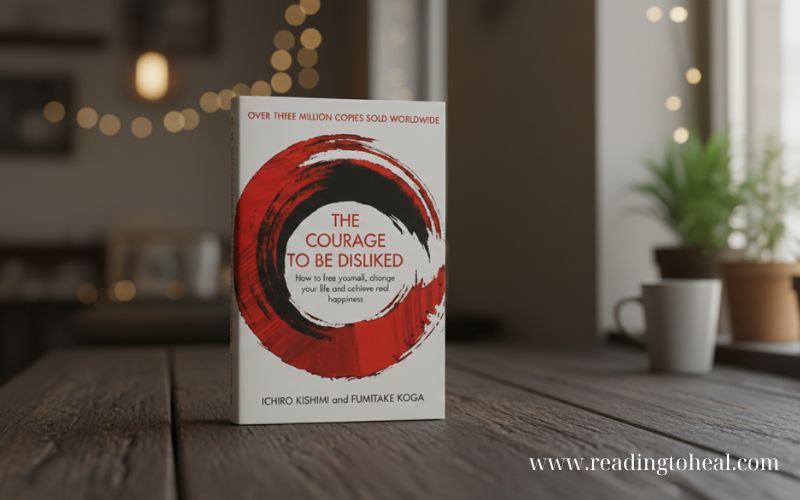
First of all, to achieve the best reading effect, Reading To Heal advises you to read it at least twice. The first time, you can focus on certain perspectives presented in each chapter and discover some special points. Then, when reading it a second time, you will easily feel that the entire book is extremely coherent and complete; the small points are interconnected, and you will not be able to help but admire the authors.
You will discover that the central idea of this book is perhaps what is stated right at the beginning: "The world is incredibly simple, and people can achieve happiness at any time."
Changing Your Perspective to Face Suffering
I believe that when exposed to psychology, you will more or less hear the name Freud, one of the three giants of psychology. Freud once proposed the theory of psychological trauma. This is a typical Etiology, meaning that to understand the causes leading to one's behavior, we must trace back to the past.
But if you blindly focus on past causes and try to explain everything solely through etiology, you may fall into an endless loop.
In the book The Courage to Be Disliked, there is a story about a person who had a childhood of parental abuse and maltreatment, and as a result, he has shut himself indoors for many years. Every time he steps out of the house, he is extremely terrified, feeling his heart race and his limbs tremble.
This has made him unable to live like a normal person, yet he still wants to go out, to work, and to create useful things for society; however, past psychological trauma has prevented his present life.
Here, if we understand it from Freud's perspective: before every result, there is a cause. My present self is the result formed by causes determined by a series of past events. Then wouldn't there be a contradiction in the above example; if all people who were hurt by parental abuse in the past did not result in psychological trauma, wouldn't that be abnormal and illogical?
To resolve this contradiction, this book is based on Adler's theory of Teleology. No matter what happened in the past, it does not affect the life of the days to follow. What determines your life is the very moment of living in the present and the purpose behind your actions, not the causes in the past.
Just as if you realize yourself frequently procrastinating and avoiding difficulties, that action is because you choose it with the purpose of temporarily avoiding the stress of fear of failure. If you realize you are angrily shouting at your loved ones, it means you chose that purpose to make the other person surrender and admit their fault before you. If you realize you are distancing yourself from society, closing your heart, and separating from the outside world - disliking meeting others and disliking communication - it is because you yourself chose to do so in the present with the purpose of merely reducing feelings of inferiority and anxiety for yourself.
"What determines who we are is not found in our past experiences, but in the meaning we give to those experiences." - Alfred Adler
If you realize the purpose behind each of your present actions, you will truly understand what the deep-seated fear in your heart is at this moment, or what your "big ego" is prompting you to do. In other words, clearly understanding the purpose behind each action is the important key to changing your current life situation. If we continue to rely on causes, we will never be able to take another step forward.
Pay attention to this. It does not mean denying that painful or unfortunate events from childhood have no impact on personality formation. On the contrary, the impact is very large. But the problem is that experience alone determines nothing; the meaning we attach to past experiences directly determines our lives. Life is not bestowed by others but chosen by oneself; how to live is decided by you yourself.
No one can choose their origin: Where were you born? In what era do you live? And what kind of parents do you have? These are not your own choices. Furthermore, these things have a huge impact if you constantly try to analyze the causes. From there, you may feel dissatisfied or feel inferior, suffering and blaming what has happened.
To change ourselves, we should not stop there. Let's start from the very present instead of going upstream to the past. By looking through Teleology, you will understand your behavior when interacting with others - that negative sufferings are all decided by you right here and now. It depends on you and has nothing to do with the past or anyone else.
Your next action is to be responsible for yourself. Will you continue to choose to look back at what happened, or focus on understanding and loving yourself more? Just as Adler said: Understanding oneself is the first step leading to change.
In summary, in the first part of the book The Courage to Be Disliked, let's remember: No matter what happened in the past, the meaning we attach to it determines the state of the present. No matter what has happened in our life up to now, it does not affect our life from now on. Remember that in the present, choosing suffering or happiness depends on your purpose and choice right now.
Editor's Note: While Adler's psychology gives you the mindset to be free, building the daily discipline to sustain that freedom requires a system. We highly recommend exploring Atomic Habits: Control Your Habits, Control Your Life to learn how tiny changes can solidify your new identity.
At the same time, The Let Them Theory by Mel Robbins reinforces a complementary truth: freedom deepens when you stop trying to control others and simply let them be. By releasing the need to manage expectations, you protect the inner independence that Adler described.
Recognizing and Completing One's Own Tasks
Recognizing and completing your own tasks, your life will become simple. From now on, once you are able to face suffering as your present self, how can you escape the suffering, unhappiness, and anxiety in life? The young man in the book The Courage to Be Disliked remains immersed in disappointment with a chaotic life, carrying the question: "How can I stop the suffering?". He goes to find the philosopher again.
The philosopher told the young man a profound philosophy: The source of suffering comes from relationships.
This perspective stems from Adler's philosophy. He believed that since humans cannot live alone in the world, it is inevitable to choose life goals appropriate for this condition, which is trying to build harmonious relationships with others.
If divided based on life stages and the depth of interpersonal relationships, each person's life consists of three major issues: work, friendship, and love.
The reason you always encounter much suffering and hurt in these relationships is that you have not distinguished clear boundaries in life. Either you are always being interfered with by others, or you are trying to interfere with others. This interference is precisely breaking that boundary.
The Roche Limit
Have you ever heard of the phrase "Roche Limit"? In fact, the universe always teaches you how to love and how to build harmonious relationships with others. The Roche Limit indicates the closest distance two celestial bodies can have. If that distance is exceeded, the smaller celestial body will shatter. The distance between the Earth and the Moon is about 384,400 km. If the Moon exceeds the Roche Limit, it will break into a hundred pieces.
We often see that in most relationships, especially in love, pain and hurt occur most often in those who sacrifice themselves to please their partners or those who easily criticize and control the other. The end for these people is often self-exhaustion to the point of collapse or losing themselves and losing motivation in life.
If you are encountering trouble and suffering in love, friendship, family, and other relationships, it means the universe is sending that person into your life and messaging you one thing: It is time for you to know how to love yourself.
So how to love yourself? It is that you always need to keep a distance and not cross the limits in relationships. This is just like what the philosopher told the young man in the book: "Recognize and complete your own tasks, your life will become simple from now on."
One's own task here is focusing on yourself, loving yourself, not trying to interfere in the tasks of others, because everything coming from outside, including other people, is beyond your control. Persisting in wanting to change or interfering in their tasks will only make you feel suffering.
Let's take a practical example. If your lover treats you coldly, that is their task. Friends not liking you is their task. Your job is to redirect your attention to focus on developing yourself; do not let emotions cross the boundary between the two.
You know what? One of the most precious sayings in this life is: "I have the right to choose." You have the right to choose to distance yourself when encountering suffering - don't get too close, don't break the boundary. When you let go and do not interfere, everything will naturally happen harmoniously and happily. This is exactly what Lao Tzu's "Non-action" (Wu Wei) once mentioned.
The person who gives up control of life is precisely the one who becomes the master of their own destiny.
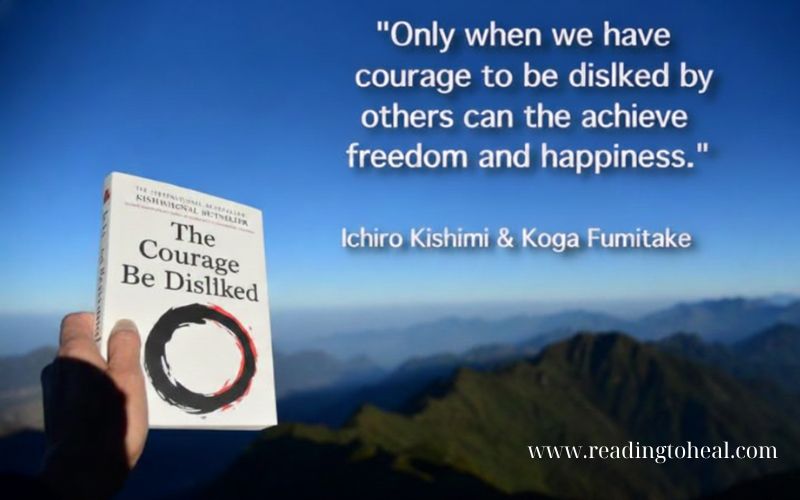
At this point, you might think: Is ignoring the world like that too selfish? People still believe that not caring too much, not interfering in the affairs of one's relatives, and not meeting others' expectations is selfish behavior. Because it's selfish, you will be disliked, which is why this book is titled The Courage to Be Disliked.
But Reading To Heal must tell you that this dislike is very unlikely to happen, because if each person in a relationship knows how to keep boundaries with others to love themselves - when you know how to fill yourself with love - your life will automatically attract more and more love.
Therefore, just be brave and have the courage to be disliked!
3 Ways to Achieve Harmonious Relationships

In the next part of the book The Courage to Be Disliked, the philosopher will point out to us 3 specific ways to separate boundaries and recognize our tasks, thereby achieving harmonious relationships.
1. Abandoning Competition
First, abandon competition. There is a saying: "Where there is comparison, there will be suffering." Most of this young man's pain in life comes from comparing himself to others. From a young age, the young man was compared to his older brother by his parents, so he always thought he was a loser.
But you need to know that the more we lack something, the harder it is to let go. As humans grow up, it is very difficult to escape the consciousness of comparing wins and losses, because the spirit of competition has been deeply ingrained in the heart. The things we hear and see in this society allow us to firmly believe that the consciousness of competition is inevitable; without competition, humans cannot progress.
But the philosopher offers the opposite view: The world does not need competition, and individuals do not necessarily have to be in a position to distinguish winners from losers. Happiness will always be like the moon in the water; the more you try to scoop it up, the faster it shatters.
In reality, you can choose another path, which is to abandon competition. When you see others making progress, you do not need to think about your own weaknesses but sincerely congratulate them. When you let go of the desire for competition will you not be interfered with by others and not interfere in the tasks of others.
2. Refusing Manipulation and Control
Secondly, the author of The Courage to Be Disliked points out that you need to know how to refuse manipulation and control.
Those who cannot distinguish their tasks from those of others will pay special attention to the opinions of the other party. In fact, because of placing too much attention on the approval and recognition of others, one is essentially trying to use their own behavior to control others' opinions. This is also a form of manipulation, but in reality, this type of manipulation cannot be carried out and will create a great burden for ourselves.
People often see bonds in the name of love between husband and wife. These types of interferences are actually due to a lack of trust and a desire to restrict the actions of the partner. In parent-child relationships, we need to be wary of the "repayment" mindset. Simply put, it is using one's own sacrifice as a reason to demand from the other person without respecting their true wishes.
Criticisms, rebukes, control, or having no independent opinion, appearing weak, and playing the victim - these are all manifestations of being in an unequal relationship.
3. Shifting from a Vertical Relationship to a Horizontal Relationship
Adler argued that inequality often occurs because society tends to maintain Vertical Relationships, meaning a relationship viewed from the top down. This trend arises from reward-and-punishment education. When this relationship takes place and becomes taken for granted, children will obediently change their behavior because they want to gain recognition and rewards. When they grow up, they will continue a lifestyle of serving others instead of following their own hearts.
A person living in a vertical relationship will tend to use it as a measure in all relationships: when meeting someone stronger, they will feel inferior; when meeting someone weaker, they will start to interfere with others with a condescending attitude.
That is why Adler advises us: Let's turn vertical into horizontal. A Horizontal Relationship is one that takes equality as its core. If a vertical relationship starts from reward and punishment, a horizontal relationship will start from gratitude and encouragement.
When satisfied with others' behavior, replace praise with a sincere "thank you." When disagreeing with something, replace rebuke with corresponding encouragement.
Courage to Change: From Community Feeling
Knowing that we must change ourselves, but how to have the courage to change? Where is that courage to be found? According to the author of the book The Courage to Be Disliked, the courage to change comes from Community Feeling.
Adler said: Interpersonal relationships are the source of pain, but at the same time, they are also the source of happiness and courage. The final destination of relationships is the feeling of community-a feeling when you consider everyone as partners in an equal relationship.
The philosopher divided the process of building community feeling into three linked steps:
1. Self-acceptance: Acknowledge and accept one's imperfect self. Love your own dark side. When you are ready to embrace your whole true self, you will no longer seek self-recognition from the outside world but focus on your own heart.
2. Trusting Others: Giving unconditional trust to others, considering each other as friends and partners, and discarding the top-down view to build an equal relationship.
3. Contributing to Others: This is considered a philosophy that all sages want you to aim for as a life mission: being willing to give and dedicate.
So many people have chosen a lifestyle lacking freedom just because they don't want to be disliked by anyone: some sacrifice their own principles to meet others' expectations, some always suppress emotions, evade reality. But it is precisely the pursuit of this recognition that has killed one's own freedom.
I wish for you to have a type of courage - the courage that Adler calls the courage to be disliked. That is also the courage to help you be happy right in the present and at any time.
The Roots of Radical Freedom
Is the "Courage to be Disliked" a modern invention? Not quite. Arthur Schopenhauer famously wrote about the necessity of solitude and the price of inner wealth long before modern psychology. Discover his "code to happiness."
Discover Schopenhauer’s Wisdom →