Arthur Schopenhauer’s "The Wisdom of Life": Finding Happiness in the Shadows
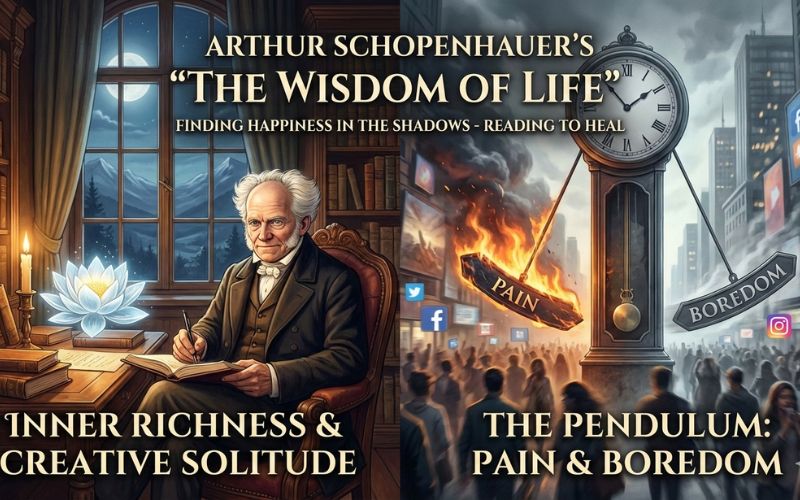
Let’s explore with Reading To Heal the path of turning inward to find the happiness that is already within us!
About Philosopher Arthur Schopenhauer
Arthur Schopenhauer was a great German philosopher who had a profound influence on many famous figures such as Nietzsche, Wagner, Freud, and Einstein. He is often called the "philosopher of pessimism," but his pessimism was not despair; rather, it was a clear-sighted look into the dark corners of human nature and the world. From within those shadows, he steadfastly sought ways to help people live more wisely and happily.
In his final work, The Wisdom of Life, he discussed happiness for the first time and asserted: To live a happy life is not about pursuing happiness, but about escaping suffering. This path to escaping suffering is reserved only for souls wishing to awaken, those willing to maintain a distance from noise, pleasure, and vanity.
"The more a man has in himself, the less he will want from other people. Those who possess inner value and abundance will find complete fulfillment without needing to sacrifice themselves to the demands of others, nor having to give up their true selves to belong to the crowd."
Conversely, the mediocre immerse themselves in social interaction and constant compromise. By understanding his philosophy, you will realize that those with a rich inner life are often difficult to get along with, or even considered eccentric - but perhaps they are the pioneers who hold the code to happiness.
Schopenhauer teaches us to turn pain into knowledge. For a broader view of how philosophy offers consolation in times of suffering, see Alain de Botton’s The Consolations of Philosophy.
THE PENDULUM OF LIFE: PAIN AND BOREDOM

Schopenhauer stated that human happiness has two hereditary enemies: pain and boredom.
He compared the reality of life to a pendulum that forever oscillates between two poles: either pain or an inescapable dullness. Poverty breeds pain; affluence leads to boredom.
-
Pain: Comes from deprivation - when we struggle for basic needs, when the heart hungers to be loved and recognized, or when the soul longs to be understood.
-
Boredom: Comes from abundance - when we have enough money and have achieved our goals but find no true meaning or value, still feeling empty.
The pendulum keeps swinging from one extreme to the other, never stopping at a point of equilibrium.
Desire and the Dopamine Loop
The pendulum Schopenhauer described is a symbol of human desire: when unsatisfied, we burn with anxiety like fire; when satisfied, we feel as cold and empty as ice.
Schopenhauer's philosophy closely aligns with the "Dopamine Loop" mechanism in modern psychology:
-
Craving a goal: Dopamine rises, driving you to act.
-
Achieving the goal: Dopamine drops abruptly; you feel empty.
-
Repetition: The brain pushes you to find a new goal to increase Dopamine again.
This cycle makes you live like Tantalus in Greek mythology, forever yearning.
The Limits of Materialism on Happiness
In the book, Schopenhauer also pointed out that the influence of material wealth on happiness never lies in the increase of numbers.
This is consistent with many social psychology studies: there is a huge difference in quality of life between someone earning $1 and someone earning $1 million. However, between someone earning $1 million and someone earning $100 million (a $99 million difference), the level of happiness remains almost unchanged after basic needs are met.
This is proven by the Hedonic Treadmill theory: when you achieve a goal (buying a house, getting a promotion), you are only temporarily happy, then quickly return to your original baseline level of happiness.
The Only Way Out
Schopenhauer and other wise sages all point to a single escape: instead of chasing the pendulum or being endlessly swayed by external factors, seek the journey of turning inward and living a life of inner richness.
THE PRICE OF GOING AGAINST THE GRAIN: BEING "UNSOCIABLE"
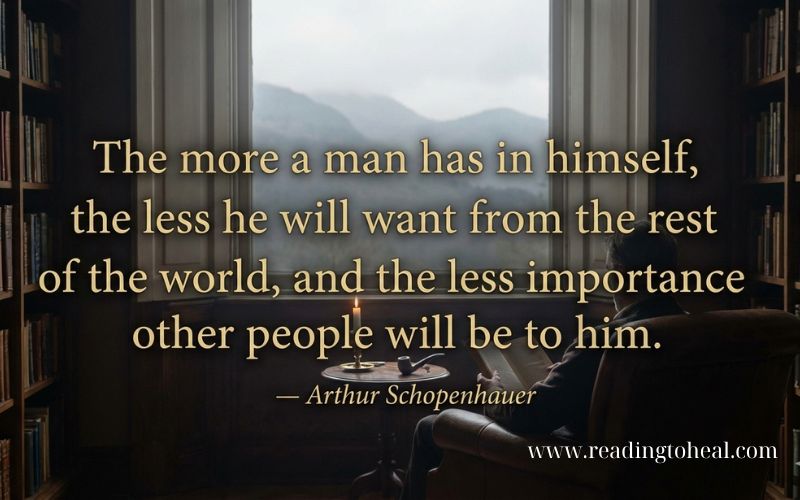
According to the author of The Wisdom of Life, the price of stopping the search for material wealth to nurture your inner life is that the richer your interior becomes, the more you will be considered "difficult to get along with."
Schopenhauer wrote: "The more a man has in himself, the less he will want from the rest of the world, and the less importance other people will be to him."
The manifestations of this difference are clear:
-
You step out of the social flow, no longer seeking self-worth through the eyes of others.
-
You refuse to participate in meaningless social gatherings and say no to useless drinking invitations.
-
You remain silent during trivial gossip, courageously end toxic relationships, and do not chase trends.
-
You do not work solely for more wealth and status.
All of this makes you an "oddball" in the eyes of others. They may think you are arrogant, unapproachable, or even mediocre and a failure because you do not meet the standards of the crowd.
The True Meaning of Being "Unsociable"
"Unsociable" here does not mean you become cold or alienated from society.
-
You refuse gatherings not because you look down on others, but because you want to spend time reading, meditating, or writing.
-
You do not compete for professional excellence not because you are lazy, but because you want to focus on work that is meaningful to you.
This selectivity causes you to lose superficial social relationships, but in return, you build deep connections with others and yourself based on sincerity.
Sociability and Harmony
We all know that society always encourages people to be "sociable," but being sociable is different from living in harmony.
Sociability without sincerity to oneself becomes artificial integration (forced laughter, maintaining relationships based solely on interest, compromising principles). True friendliness is smiling sincerely at a street sweeper but refusing to party with the corrupt; it is listening deeply to a stranger's story but never pretending to agree with something against your conscience.
The secret to wise living lies in dancing the "tango" with the world: advancing, retreating, and spinning, but never losing your own inner rhythm. Those with a rich inner life redefine social connection, and the most important thing to them is connecting authentically with themselves first.
HOW TO LIVE A LIFE OF INNER RICHNESS?
When a person turns toward enriching their inner life, they naturally minimize desires to reduce distress. Here are the core principles suggested by the author of The Wisdom of Life:
Learn to Let Go of Worries and Regrets
According to Schopenhauer, the most important thing is learning to let go of worries about the future and regrets of the past to enjoy the present. Schopenhauer advised: "As regards the future, we should look upon the potential outcomes as though they were never to happen. Do not let tomorrow and yesterday rob today of its breath."
Know Exactly What You Want to Do
Understanding oneself is the first door to freedom. When you clearly understand yourself, you will know what you are good at and what your life's role or mission is. To reach understanding, we need to practice discipline and accumulate knowledge. Schopenhauer was fluent in seven languages and considered books spiritual friends that helped him converse with great minds.
Dedicate Time to Creative Solitude
Schopenhauer declared that one must choose "either solitude or vulgarity" because humans have only two choices: Dare to be alone to nurture wisdom, or merge into the crowd to become a faded version of someone else.
Maintain a Calm Mind Above All Else
We should not be too happy or too sad about anything. Our judgment of whether something is "good" or "bad" is actually an illusion. The important thing is to keep our minds calm, not letting emotions carry us away excessively. Do not be overjoyed by success, and do not drown in sorrow.
Health is the Foundation
"A healthy beggar is happier than a sick king." According to him, the greatest folly is to sacrifice health for any other kind of happiness. Health is the "one," everything else is "zero."
CONCLUSION AND MESSAGE
In an era where material abundance produces an unprecedented spiritual desert - with the rise of FOMO, virtual living, burnout, and dependence on AI - humans are gradually losing the skills of direct dialogue and independent thinking. Many people spend a lot of money on expensive Yoga and meditation, yet still cannot detoxify their souls from desire.
However, in the midst of this vortex, there are still many awakened people who choose a different path: They turn inward, building inner wealth. They meditate, live materially simple lives, enjoy being alone, and delve deep into philosophy.
The "unsociability" of these people is not an anti-social pathology, but a conscious choice after seeing through the nature of existence.
Which path will you choose? Turning inward or continuing to seek happiness from the outside? Share with us via the Reading To Heal Fanpage!
DEEP DIVE: CONNECTING PHILOSOPHY TO MODERN GROWTH
The timeless wisdom of Arthur Schopenhauer serves as the foundation for many modern psychological and habit-forming frameworks. To deepen your journey of inner richness, consider how these three contemporary works bridge the gap between 19th-century philosophy and today’s world:
Hardwiring Happiness: Escaping the Negativity Trap and Rewiring Your Brain
Schopenhauer focused on "escaping suffering." Dr. Rick Hanson’s work provides the neurological tools to do exactly that by teaching you how to "install" positive experiences into your brain to counteract the natural negativity bias.
The Price of Freedom: The Courage to Be Disliked
This mirrors Schopenhauer's take on being "unsociable." It explores Adlerian psychology, teaching that true freedom and the path to inner peace require the courage to stop seeking validation from others and accept being misunderstood by the crowd.
Atomic Habits: Control Your Habits, Control Your Life
To move from a "Dopamine Loop" to a life of "Creative Solitude" requires a system. James Clear’s framework helps you automate the daily rituals of health and learning that Schopenhauer considered the bedrock of a wise life.