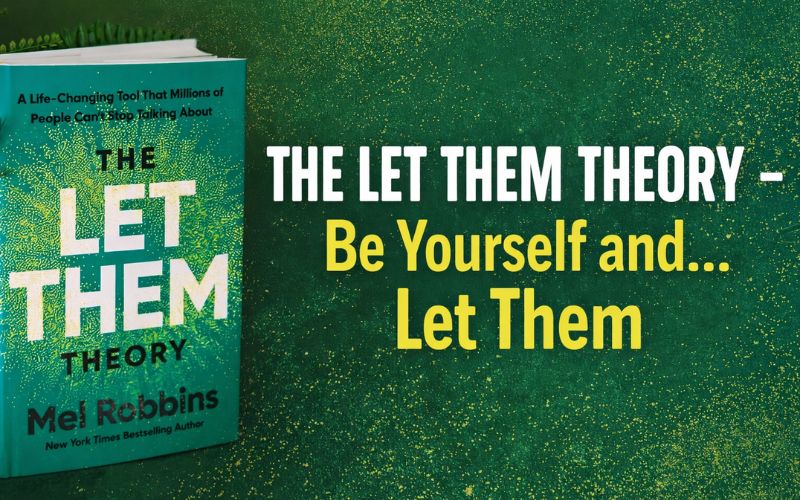
The Let Them Theory - Be Yourself and… Let Them
Have you ever wondered why some people are able to maintain serenity and composure in the face of groundless judgment, insults, or injustice? What helps them avoid being swept away by fleeting emotions, refusing to let external noise invade their internal stillness?
Looking back through history, you will encounter the Buddha himself. Once, while preaching, he was pelted with objects and cursed at with terrible words by locals, yet he showed no resentment. His mind remained calm as he gently replied:
"If you bring a gift to someone and the recipient does not accept it, to whom does that gift belong?"
Then there is Socrates - the great Greek philosopher. When sentenced to death by poison based on absurd allegations, he did not complain or harbor hatred; instead, he prayed for forgiveness for those who harmed him because of their own ignorance.
You will see that from East to West, from philosophy to Buddhist teachings, we are shown that humans are only truly free when the inner self is no longer dominated by the words, actions, or evaluations of others. True peace does not come from controlling the outside world, but from the ability to dwell firmly within one's own inner self.
To nurture such a resilient interior, today we will temporarily set aside philosophical concepts or religious dogmas. Instead, we will explore a tool that seems simple yet is incredibly useful in helping you practice day by day to head toward your own calm, peaceful inner state amidst a life as complex and chaotic as it is now.
If the gazes and opinions of others or their actions continue to disturb your mood and make you overthink time and time again; if the success and happiness of others cause you to live in comparison and become paralyzed in your own procrastination; or if you are overly frustrated and disappointed in your desire for others to change... and if you still want to try to control someone else's life, then today's book is for you. It is for the person being pulled into negative energy by the desire to control everything according to their own will.
The book is titled The Let Them Theory by the internationally renowned author and speaker, Mel Robbins. She was honored by Focus magazine as one of the 50 most influential people over the age of 50 globally. Her books have been embraced by millions, applied, and have changed lives positively.
If you have heard of "The 5-Second Rule" to effectively stop the loop of procrastination and laziness, she is the author. However, she realized that to solve the root of the problem, the 5-second rule is still not enough when you are wasting too much energy looking outward and trying to change things beyond your reach; that only consumes energy in vain.
So now, let’s join Reading To Heal to see what we can learn through Mel Robbins' "The Let Them Theory."
For readers interested in deeper reflections on freedom, identity, and inner peace, explore more titles in our philosophy and spirituality book collection.
Letting Go of the Need to Control – The Root of Suffering
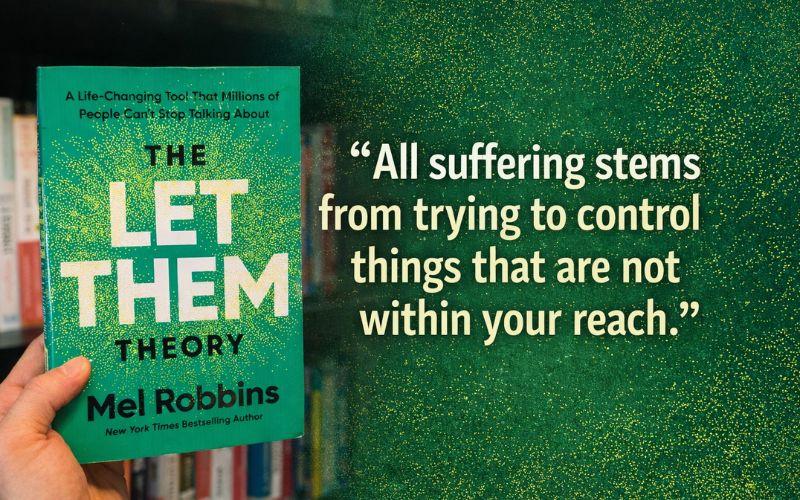
All suffering stems from trying to control things that are not within your reach.
Everyone wants things their way
Psychologists have pointed out that the desire for control is an innate need for all of us. Whether it is thoughts, time, actions, living environment, or future plans, when we hold control, we feel safe and comfortable.
But if this instinctive need for control is not recognized with moderation and set within right limits, it will overflow into all aspects of life, soaking deep into the smallest things. Especially in a competitive, comparison-filled flat world, people are even more driven to control more things. Wanting everything to go one’s way, paying excessive attention to how others evaluate us, or being obsessed with plans unfolding exactly as intended causes us perpetual fatigue, anxiety, and stress.
We cannot fight our own instinct to control; rather, we need to learn to accept and understand it to let go of the excessive need for control.
In reality, every craving for control originates from one fundamental thing: fear.
Fear that others won't like us, fear of being judged, fear of being left behind, fear of loss, hurt, or breakdown, fear of suffering...
But psychologists also point out that while control is an instinctive need, it only provides an illusion of safety. No amount of control truly makes you feel better; on the contrary, the more you try to protect yourself from pain, disappointment, or the rejection of judgment, the more the fear within you is amplified, increasing your levels of stress and anxiety. You then get sucked deeper into the need for control.
It is likened to a continuous downward spiral. As this spiral goes down, you become more stressed. When stress is prolonged, you easily fall into self-doubt, procrastination, feelings of negative burnout, and easily indulge in habits that provide urgent dopamine hits like gaming, eating sweets, scrolling social media, or constantly comparing yourself to others - thus losing your own clarity.
You likely already know that the thoughts, opinions, actions, and choices of others are things none of us can direct, change, or control. Life is the same - fluctuating with ups and downs, joys and sorrows that are not predetermined. Just as no one can make the weather - sun, rain, wind, or storm - happen according to their will, you will never be able to control what is not in your hands.
As the philosopher Epictetus said:
"Some things are within our control and some things are not. If you confuse the two, you will fall into suffering."
The larger the ego, the more it likes to control
The nature of a person with an excessive need for control is actually someone who is internally weak and nurturing a large ego. They crave to be recognized, praised, and evaluated correctly, so the gaze of others is like thousands of strings tied tight, constantly pulling at them. They also cannot stand others evaluating them negatively. A single word of criticism or a cold, judgmental look is enough to make their inner self waver, their mind restless, and drive them to rescue or prove their image in the eyes of others.
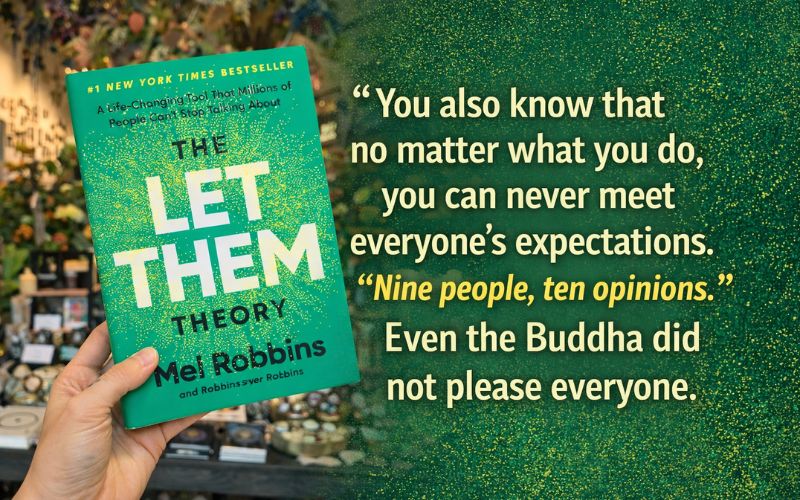
You also know that no matter what you do, you can never meet everyone’s expectations. "Nine people, ten opinions." Even the Buddha did not please everyone.
Thus, you will only exhaust yourself by holding onto an oversized ego while chasing after others. But realizing this does not mean we can all just stop controlling things beyond our reach.
Therefore, the author introduced The Let Them Theory as a mantra to remind you, or like a switch in your brain you can flip anytime your desire to control the impossible arises.
It acts as an anchor in the mind, reminding you to focus only on what you can control: yourself. Your words, thoughts, actions, and reactions are what you need to pay full attention to. This mindfulness helps you stop handing over the power to determine your thoughts, moods, actions, and life to others or external circumstances, instead maintaining mastery and thereby releasing your own power.
When someone shows they don't like you, likes to judge, or talks behind your back, let them. If someone is dissatisfied or disagrees with you, let them voice their opinion. If someone attacks you, let them. You can entirely choose silence as a way to protect yourself.
As the saying goes: "Your silence will never be misquoted." At the same time, that silence returns the attack in full to the speaker. People often mistakenly think that silence in the face of an attack is weakness, cowardice, or losing. But no, it is simply that you have transcended the need to react; you do not allow yourself to be pulled into a negative energy field that adds fuel to the fire and causes more hurt, nor do you need to prove yourself right to someone who will never choose to understand.
The Buddha taught that keeping silent when insulted is like holding a bright lamp in the darkness. The light of silence will illuminate the wisdom within you and even move the other person. You also don't need to navigate your life by trying to predict what people say and think about you. Let them live with their own perceptions within their worldview. They have the right to do so, and you have the right to choose not to explain, not to please them, and not to expect them to have a good or sympathetic view of you.
Remember what the author tells you:
Even if you break your neck trying to please everyone and make everything go smoothly, there will still be someone who thinks negatively and is dissatisfied with you. When you stop controlling how others think about you, you will realize true peace is not something others bring, but lies in your own choice. Choose not to hold onto what doesn't belong to you. Devote that vital time and energy to hobbies, habits, and things that bring happiness and meaning to your precious life.
On the other hand, in life, you will frequently face undesirable situations. Traffic jams, delayed flights, noise from others, difficult customers, colleagues shirking responsibility, rain on your vacation day, children accidentally causing trouble... making you uncomfortable, frustrated, angry, and driven crazy.
Countless situations in life can make the "black wolf" inside you want to rise; in those moments, apply The Let Them Theory, give yourself a moment of silence, and tell yourself: "Let them."
Let things happen
Let things happen; they are simply what needs to happen.
You cannot control all those things. The more you try to resist them with a negative mindset, the more you become a slave to endless external factors that dominate your mood and drain your motivation and clear focus. You can only control your reaction to all those situations. When you change how you react to a stressful or uncomfortable situation, your mind and emotions will immediately be soothed.
Studies show that most of your emotions come and go within 90 seconds if you do not react to them, but instead allow them to rise freely and simply observe them. Accordingly, when emotions are calmed, the prefrontal cortex of your brain escapes the stress-induced survival state and begins to take control. At this point, you will have clearer judgments and behaviors rather than "losing your wisdom to anger."
The more you practice, the more you will clearly see that the things that frustrate you are truly not worth spending your time and strength on to consume your inner peace. The less you react to them, the more you "let them be," the stronger the composure within you grows and the clearer the wisdom within you reveals itself; the better you can resolve problems.
Of course, "Let them" is not a tool for you to ignore your own responsibilities, live stagnantly, lonely, detached, and indifferent to those around you, or turn yourself into a doormat for people to trample on. That is only half the journey of removing external chains to reach the next stage: living freely and autonomously as your most mindful self.
The other, more important half is being ready to take responsibility with the affirmation: "Let me." Let me be responsible for my own life. I react and act based on the core values I aim for. When combining "let them" and "let me," you constantly sharpen yourself to become a better version of yourself.
But the motivation does not stem from the scrutiny or criticism of others, but because you choose it. You strive no longer to prove yourself to anyone, but because of the constant desire for growth within you. You even care for, give to, and love others because of the goodness blooming within you, not to be liked, recognized, or to trade for anything.
And with "let me," you reduce complaints, reproaches, and blaming unfavorable circumstances or others for the difficult situations you encounter, saving that energy for creating the changes you want to see. You learn to be calm and ready to accept all the impermanence life brings, viewing everything as merely an experience.
Directing the Comparison Habit and Gratitude
Do you think this life is fair? When looking through mortal eyes in this limited human life, it's hard to see life as fair, isn't it?
Some are born into full, loving arms. Many others must start with many deficiencies, hurts, and struggles in every direction. Some possess attractive looks, and the world naturally favors them. But many others are self-conscious and hate their own reflection every time they look in the mirror. Where does true fairness lie when you can see the shadow of inequality everywhere?
Life is inherently unfair
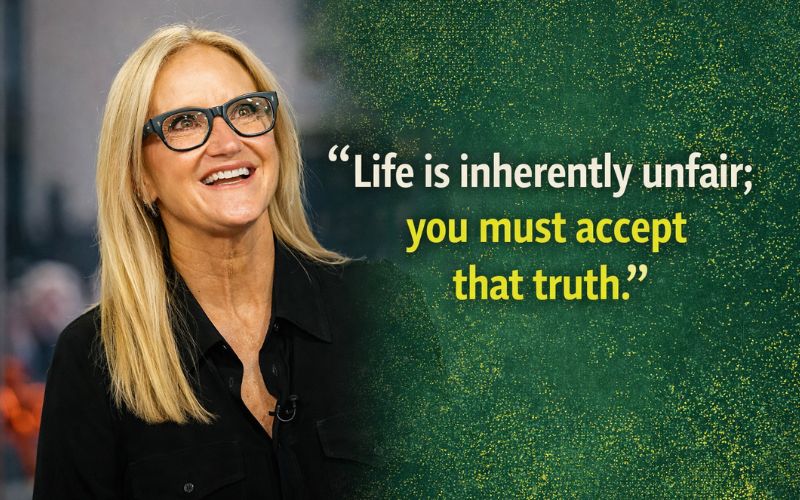
The author of The Let Them Theory says that life is inherently unfair; you must accept that truth.
Stop worrying and comparing what others have, stop complaining about the fate of your life, and stop letting yourself be sucked into a negative comparison spiral only to turn your back on your own true value.
In fact, comparing yourself to others is an instinctive story. It is something humans needed since the dawn of time to assess their own position in the herd to ensure survival. So the problem is not in the tendency to compare, but in the impact you create when you compare yourself to others. Comparison can be very toxic if it makes you feel inferior or unlucky. From there, it erodes self-esteem, drains motivation, and holds back your development.
This is the kind of comparison that pushes you into complexes, envy, and a chronic sense of helplessness. As the sage Krishnamurti said:
"Comparison is a form of violence against oneself."
Let comparison create motivation
Look at it from another angle: just like the need for control, we cannot fight our instinct to compare. So, let comparison give you the motivation to strive instead of belittling yourself. Let the success and happiness of others guide your success and serve as inspiration to push your own journey forward.
First, understand that all the fixed traits of others - such as appearance, family background, origin, innate talent - are things a person is born with, not achieved through effort. No matter how hard you try, you cannot change that starting point.
And it is only a starting point, not the deciding point. Therefore, every time you find yourself comparing yourself to others, ask yourself: Is this something I cannot change, or something I can use my own effort to change the outcome of my life?
If it is impossible, let go. If it is possible, see their success as a reminder that you can too.
When you constantly learn, move forward, and persevere to the end, good results will surely come to you. Happiness, success, money, or a better version of yourself are infinite resources available to all of us; no one is competing with you for them.
Understand that your envy of what belongs to others is an invitation for you to strive to become a better version of yourself. A version that is no longer afraid, no longer procrastinating, no longer making excuses, and never stops striving.
Let me begin to take action and train relentlessly. Let my energy be directed toward consistency, determination, and the will to pursue goals to the end to write the most meaningful chapters of my own life. Because destiny is not fixed; it will always flow according to your habits and life choices every single day.
Always be grateful to life
Look up to strive. But in times when you feel too negative, don't forget to look down to generate gratitude. Look out at the world to see that you are much luckier than many others.
The life you are living today is one that millions of people around the world dream of having. They wish for a place to live, food to eat, good clothes to wear, a job to do, internet for entertainment...
So you are not unhappy at all; you are actually being favored. Always let gratitude be the medicine that saves you from dissatisfaction and injustice, helping you rise from the deadlocks on your own life path.
Don't Try to Change Others – Be an Example
You cannot make someone wake up unless they are ready.
Have you ever tried to change a person? Working hard to advise a friend to spend less recklessly; advising, urging, or even angrily judging the bad habits of a spouse just hoping they will know how to maintain health and live more wholesomely; encouraging then scolding children to study hard and strive so they suffer less later; advising colleagues to change their working style; advising someone not to waste their youth and instead study hard, read books, and develop good habits for the future; or even trying to advise someone not to care too much and torment themselves over others' evaluations.
But how positive were the results? You need to know the truth: a fundamental law of human nature is that everyone needs to feel they are in control of their own life decisions. Therefore, when you advise them or pressure them to change, the pressure from losing autonomy will cause them to resist your advice, no matter how good it is. Do you think they don't understand what is truly good for them? Or that they've never thought about changing? They understand perfectly well, and it’s not that they’ve never wanted to change, but changing is a difficult challenge for everyone - it is never easy to truly change.
2 Motivations for a person to change
What a person needs to change is motivation. But the more you want them to change, the more you advise and urge, the more they lose motivation. Weary sighs, disparagement, or harsh criticism will only make things worse. Motivation here usually comes from two directions.
First, your own positive change, when significant enough, will provide them with motivation - provided that in that process, you completely let them be themselves without needing to advise, expect, or pressure them to change anything.
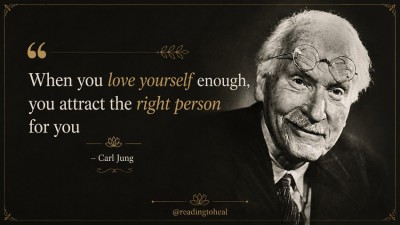
Let them be them, and you lead the way as an example for them, as affirmed by psychologist Carl Jung:
"Don't try to turn others into the version you desire. Let them become themselves, and you become the light to guide their steps when they need it."
The second motivation comes from pain. When they are in enough pain from the consequences of what they are doing, they will have the motivation to change.
Everything is futile until that person begins to taste the pain of paying the price for stagnation; at this point, they will change voluntarily without you needing to say a word. Therefore, do not interfere with the karma of others. Don't try to change a person with words, money, or power when they persist in staying stuck in their own problems. Some people absolutely must taste the flavor of pain to learn how to truly grow. Trying to pull them out of the dungeon will only prolong their own growth process.
Just… Let Them
Remember a lesson in The Let Them Theory:
You cannot make someone wake up unless they are ready. Every forced attempt will create resistance.
Don't try to fight the pre-programmed system in the brain. It is no different from trying to swim against the current; the harder you try, the more exhausted you get without reaching the destination, wasting time and energy and destroying your relationship.
A person will only change when they feel they want to change. Let them be, and focus only on yourself - improving yourself every day, becoming a living model for what you also want to see in others; only then can you bring influence to them.
As author Byron Katie once said, the only way to lead others is to live as an example.
A calm but disciplined father will teach his child about strong will more effectively than any moral lecture. A mother who loves herself, takes care of her health, and maintains peaceful energy will make her children learn how to cherish themselves without needing many words.
If you hope your loved ones know how to cherish and protect their health, take care of yourself to be healthy and full of life energy to love and care for them. If you hope your friends and relatives know how to manage finances, show them how effectively you have mastered your own money.
Be patient and give others enough time to create a positive impact in their subconscious. This process may take at least 6 months. The true transformation of the person beside you will quietly come from internal resonance when they realize you have less resentment, no more judgmental words or complaints; when they see you calm before life's events, disciplined in work, kind in behavior toward others, witnessing you live an autonomous, healthy, disciplined, and energy-filled life.
They will unconsciously gravitate toward you and step forward with you, just as a seed will naturally seek the light. No one can force a seed to sprout, but when all factors converge - good soil, enough water, abundant light - it will know the time to stretch itself.
"Let Them" to Master Life and Enjoy Your Own Journey

The message from the book The Let Them Theory can be summarized in one sentence: you should not care too much about evaluations from others.
This book has helped tens of millions of people around the world practice and provide incredibly positive feedback, and you can be one of them. Stop wasting your energy and time on what others say about you. Whatever they say or think, let them. Stop scrutinizing the eyes and moods of others and stop letting the fear of being judged prevent you from pursuing your own dreams. Don't let the success of others make you shrink in a complex.
Start your own steps of effort.
Stop the urge to make others change into the version you desire. Let others be themselves with their own choices, journeys of mistakes, and their own growth. And you, be yourself. Let go of control, master your own life, dare to commit, dare to take responsibility, and dare to enjoy life in your own way.
The ideas in The Let Them Theory echo many timeless insights found in other philosophy-driven self-growth books. If you’re drawn to themes of emotional independence and radical acceptance, you might also enjoy The Courage to Be Disliked, which explores the liberating power of self-acceptance from an Adlerian perspective.