
Anger: Wisdom for Cooling the Flames - A Precious Book by Zen Master Thich Nhat Hanh

The seed of anger is no different. In reality, we never want ourselves to become angry in any situation, yet when events occur, it is difficult to restrain our rage; we are ready to utter bitter words that hurt others, acting irrationally or even violently.
In the book Anger: Wisdom for Cooling the Flames (hereafter referred to as Anger), Zen Master Thich Nhat Hanh points out the reasons why the seed of hatred grows unconsciously to control our behavior, why it is so difficult to restrain our own anger, and how to escape those fits of rage to reclaim self-mastery and stop hurting those around us.
4 CAUSES OF ANGER
Among the books by Zen Master Thich Nhat Hanh, Anger was one of the first that Reading To Heal encountered. This is also the book that helped me understand why I was often so angry and what causes trigger that anger...
Anger from what we eat
Did you know that food can also trigger hatred within us? Zen Master Thich Nhat Hanh believes that animal products today mostly come from livestock raised in cramped, suffocating environments full of stress and fear.
When we eat animals filled with the terror and anger of being slaughtered, we simultaneously consume that hatred into ourselves.
Furthermore, because these animals lack contact with the natural environment, their resistance is very weak; they are injected with all kinds of vaccines to prevent disease and antibiotics to treat them.
Most of the food they eat is industrial feed designed for rapid growth, leading to chemical residues in their bodies, which are transferred into our bodies when we eat them. These residues become toxins, causing many illnesses.
On the other hand, our material conditions today are much more abundant than before, so eating is no longer just about filling the stomach or eating when hungry. Some people eat excessively to forget sorrows or depression, seriously affecting the digestive system.
An excess of energy without knowing how to process it causes it to turn into the energy of hatred, sex, and violence.
Therefore, the advice of Zen Master Thich Nhat Hanh in the book Anger is to eat animal products from naturally raised livestock and organically tended plants. Though they may be more expensive, by eating less, our health will improve significantly.
Anger from the information we consume
In the book Anger, the Zen Master suggests that our ears, eyes, and consciousness also consume hatred.
We cannot deny that the blooming of media brings many practical benefits for work, entertainment, and providing useful information for daily life.
However, along with that, the toxic information we consume is a downside contributing to our anger, such as: a series of news reports on robberies and murders, scandals, "stone-throwing" or "exposing" sessions, and fabricated information aimed at attracting the online community... All this toxic information pervasive on social media platforms silently affects our brains.
This is because our brains love negative things. Why is that? There are two reasons:
-
Physiological reaction: Researchers have shown that the brain's response to negative stimuli operates at a stronger intensity than positive stimuli. This is because the amygdala and brain structures related to emotions are stimulated and sound an alarm; at that point, about two-thirds of neurons are mobilized, and negative experiences are quickly stored in memory.
-
Social factor: Our tendency is to focus more on negative things to draw lessons for ourselves, thereby ensuring survival.
Build your soul's health by practicing mindfulness in consuming mental products, trying to stay away from products that are toxic to the spirit.
The environment we live in also generates anger
Zen Master Thich Nhat Hanh tells a story of a 12-year-old boy living in a family frequently subjected to verbal abuse and harsh scolding from his father. He only knew sadness and endurance, but he whispered to himself that when he grew up and had a family, he would never treat his children that way.
However, on another occasion while visiting Plum Village with his younger sister, the sister accidentally fell while sitting in a hammock. The boy instinctively became angry and scolded his sister harshly, in the exact same way his father had scolded him.
As we can see, the environment we live in - especially our own families - can silently nourish the seed of anger within us through words of dissatisfaction, resentment, and bitterness from childhood. That anger grows until it erupts without us realizing it, just like the 12-year-old boy above.
It can be said that parents themselves were those who had to grow up in such toxic, hatred-filled environments; they did not know how to transform it, so they passed it on to their children.
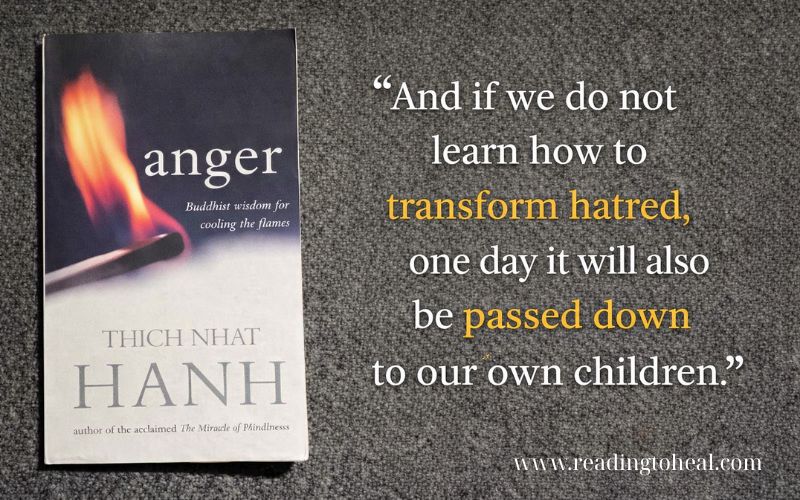
And if we do not learn how to transform hatred, one day it will also be passed down to our own children.
Furthermore, in the industrialized society we live in today, we have very little closeness to nature. The living environment is becoming increasingly suffocating, with noise, light, and air pollution making it easier for us to become stressed and tired. Anger can more easily arise from there.
Work may bring much pressure and busyness, but spend as much time as possible returning to nature. Walking barefoot on grass or sand, immersing yourself in the wind and sunlight will be a very effective solution to help relieve the stress that is the source of arising frustrations.
Misunderstanding the nature of anger
After reading the entire book Anger, I realized that until now, I had misunderstood the nature of anger. And this very thing creates a habit that prevents us from ever escaping the control of rage: the habit of blaming.
We completely blame others for making us angry, making us suffer, but is that really the case? Have you ever wondered why some people in the same situation as you do not get angry? Why can they remain calm while you cannot?
Anger already exists in the depths of each of our consciousnesses in the form of a seed of hatred. But the seed of anger in you is too strong; it has been watered too much by the times you were angry in the past because you did not know how to face it or practice, so you unconsciously let that seed grow stronger day by day. Every time you blame someone else for causing your anger, the seed of hatred within you grows larger.
You can see this clearly manifested through statements like: "Because you were naughty, Dad is very upset," or "Because you were late, I am very annoyed and it seems you don't respect me"... In short, the common denominator is: "If only you had acted correctly, I wouldn't have had to be angry," and then you turn your anger into someone else's responsibility.
We usually never take responsibility for our own emotions, so there is never a real effort to change. Blaming others for causing your angry emotions is irrational because the process of developing your emotions is not a passive state; whether you are conscious of it or not, you actively create your own emotions. You actively make yourself angry because of someone else's action.
Next is because you have wrong perceptions, also known as ignorance (avidya) in Buddhism. Ignorance causes us to be overwhelmed with fear when facing a problem; fear and anxiety then cause fits of rage.
Wrong perception occurs because we misunderstand, because we perceive the nature of an issue, event, or person not as it truly is.
We limit our perception and judgment of everything through our own subjective lenses formed since childhood, through accumulated experience and knowledge, leading to skewed evaluations. This causes misunderstanding - the root of all anger and hatred.
The final thing that causes our anger to erupt is suppression. Regarding anger, many people are used to suppressing it by trying to push it away, telling the other person they are fine and not angry at all.
But this is an action that leaves enormous consequences because the suppression of these rages, when accumulated enough and for long enough, exceeds the body's endurance. It will create a hurricane of fury poured onto those next to us, especially loved ones - the people we can easily utter hurtful words to.
CONSEQUENCES OF ANGER
In the next part of the book, we will explore the consequences of anger.
Venting anger on others, destroying relationships
Our most common attitude toward anger is probably venting it on the person we think hurt us. We consider it a way to punish the opponent; only when the opponent suffers do we feel comfortable and satisfied.
Many people do not intend this, but in action, they unconsciously create this result because of the deep root mentioned above: blaming others for causing their angry emotions.
The consequence is the escalation of suffering for both sides, leading to injury and the breakdown of the relationship.
On the other hand, have you noticed that the closer someone is to us, the easier it is for us to lose our temper and hurl negative criticisms at them?
Why is it that toward strangers in society, we often behave politely and gently, but are ready to vent anger, criticize, and punish loved ones with hurtful words, silence, or violence?
Is it because we borrow the power of love and take for granted the right to say unkind things in heat of the moment, thinking that no matter how extreme we are, they will still forgive and overlook it? Is this a right and mature action? Does that person deserve such treatment?
Inability to face and overcome rage
Imagine for a moment: if you discovered your house was being set on fire by someone else, at this very moment, would you find a way to extinguish the fire for the house, or would you run to find the person who set it? We would obviously put out the fire for our house first, wouldn't we?
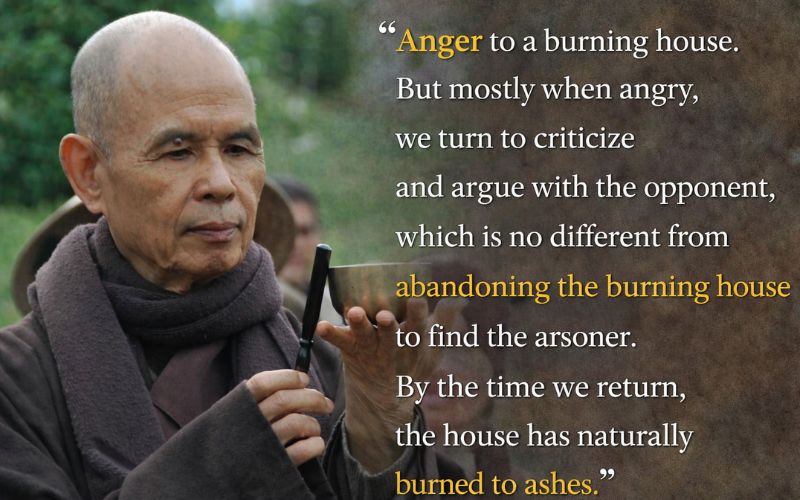
Zen Master Thich Nhat Hanh likens our anger to a burning house. But mostly when angry, we turn to criticize and argue with the opponent, which is no different from abandoning the burning house to find the arsoner. By the time we return, the house has naturally burned to ashes.
We do not know how to face and overcome anger; instead, when angry, we usually do not think and let ourselves drift along with our frantic emotions at that time. The anger does not decrease because of that. If we only focus on confronting and arguing with the opponent while angry, it means we are also gradually burning down our own souls.
Have you ever seen someone trying to suppress the fire of anger burning within them? On one hand, they always say "I'm okay," "I'm not angry," "I'm fine," but on the other hand, they are trying to suppress the manifestation of anger. Suppression of anger is actually a form of lacking skills to cope with anger; suppressed long enough, it will eventually explode, and then it is more terrible than any ordinary fit of rage.
Damage to physical health
Modern medicine has proven that physical illness can be caused by the spirit, and mental illness is also influenced by the physical body. Buddhism also holds that body and mind are inseparable; the two are one and influence each other.
The Buddha taught that anger is one of the Three Poisons of the mind, along with greed and delusion; it can cause cardiovascular diseases such as atherosclerosis or coronary heart disease.
Did you know that having an unhealthy heart means your blood is circulating very poorly, which is the main cause of many other illnesses?
On the other hand, when we are angry, the body secretes too many hormones that cause a state of stress. When we are frequently stressed, it is very easy to turn to stimulants like cigarettes, alcohol, or drugs, or even eat too much to dispel this feeling of tension.
From here, an unhealthy lifestyle is formed, greatly impacting both physical and mental health.
You see, fits of anger seem like a normal reaction for everyone, but we almost rarely think about the consequences they leave behind, so it is very difficult to have the right behavior to deal with our own anger.
HOW TO OVERCOME ANGER
So how do we rise above anger? In the next part of the book Anger, Zen Master Thich Nhat Hanh points out step-by-step practices for us.
First: Recognizing the anger
Most of us, when angry, find it very difficult to control our emotions and words. We are too used to reacting with words or actions whenever angry just to somewhat relieve that anger.
This rut in facing and handling anger will only make subsequent fits of rage stronger and burn us more intensely.
So, the first step the Zen Master advises us is to recognize the anger.
This means you need to clearly identify the source leading to your anger: it could be someone, some information, or anxiety and fear regarding a problem you encounter.
When we can identify the cause of the anger, we are consciously looking deeply into our anger, helping it not to erupt instantaneously out of habit as before.
Second: Delaying the reaction
The American philosopher Thomas Paine once said that the most effective remedy for anger is delay.
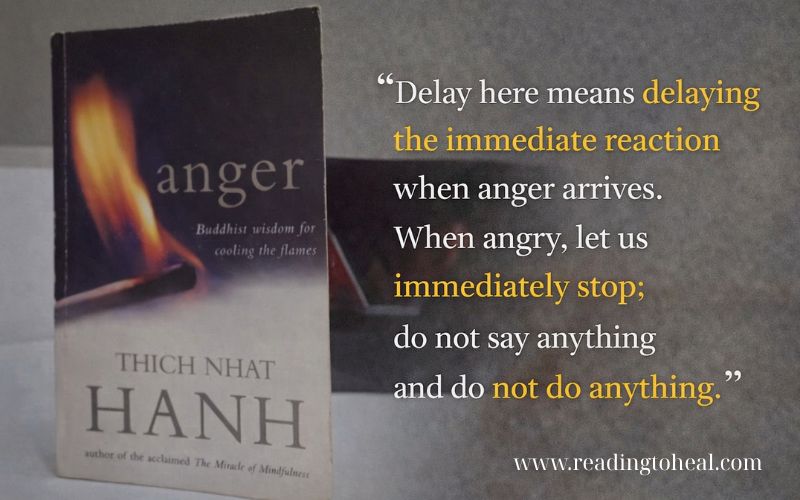
Delay here means delaying the immediate reaction when anger arrives. When angry, let us immediately stop; do not say anything and do not do anything.
At this time, use mindful breathing or perhaps mindful walking to clearly feel how the anger is flowing in our bodies.
Stopping and looking deeper into the incoming anger at this moment will be truly helpful; it is the decisive factor in whether you succeed or fail in facing your anger.
If you do not practice looking deeply into the anger at this point, you will easily manifest a series of unwanted reactions that will make you regret later. Remember that any feeling - whether joy, sadness, pleasure, anger, or disappointment - will eventually pass. Therefore, to avoid hurting yourself and those around you, just stop to delay the habitual immediate reaction.
Third: Embracing the anger
Zen Master Thich Nhat Hanh describes our anger as a crying baby that truly needs the embrace and comfort of a mother. Therefore, you should regard your anger as your own child in need of love, soothing, and comfort.
Use the energy of mindfulness to do that, because everything in your body, if illuminated by the energy of mindfulness, will be transformed.
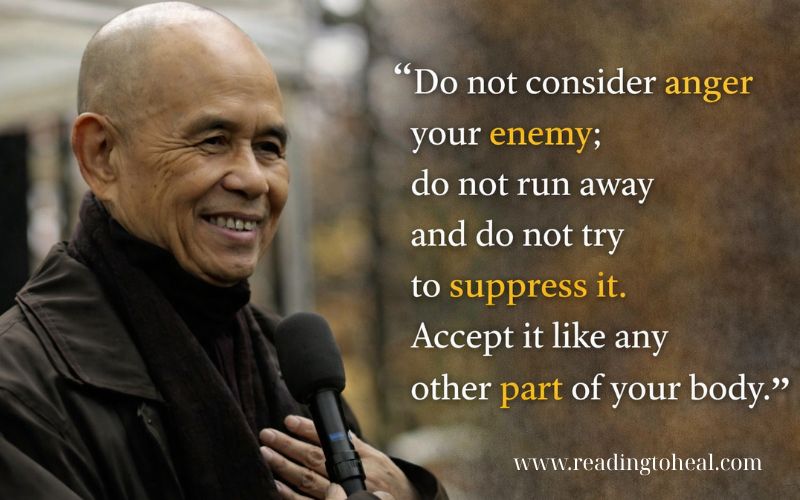
Do not consider anger your enemy; do not run away and do not try to suppress it. Accept it like any other part of your body.
If your stomach hurts, you need to care for it so it hurts less; if your leg hurts, you need to rest and massage it to soothe the pain. Your anger is the same; when it erupts, take care of it, gradually transforming it into positive energy:
"Breathing in, I know I am having a feeling of anger; breathing out, I accept my anger. Breathing in, I smile at my anger; breathing out, I let go of my anger."
In this way, the anger will gradually shrink and be transformed by the light of mindfulness. Creating and nourishing the energy of mindfulness will help our body and mind become one, so we can always appreciate the very present moments in which we exist. From here, we will appreciate being with loved ones more, leaving no room for anger to creep in.
Practicing mindfulness is not difficult and does not require a long time to practice; just one hour can make you more mindful. It can be practiced while you are doing anything - eating, drinking tea, reading, working - by bringing the body back to the mind in the present moment, focusing completely on the present moment, not letting the past or future disturb you.
Fourth: Using loving speech to share about the anger
Recognizing, embracing, and soothing the anger does not mean we should not share our anger with the other person, but now the difference is that we can share in calmness.
Use loving speech to tell the other person that you are angry and suffering; do not remain silent for more than 24 hours - it is no different from keeping poison in your body. There are 3 important sentences you need to say to the other person:
-
"I am very angry, I am feeling very uncomfortable or suffering, and I want to say this not to blame you, but because I am facing my own anger and want to take responsibility for it."
-
"I will try my best to take care of the anger so it gradually passes."
-
"Please help me."
Such messages of loving speech can also make the other person wake up and examine themselves to see what they did or said that made you suffer. Through such voluntary action, the relationship will be nurtured and deeply bonded.
Fifth: Helping others transform anger by listening with compassion
In the book Anger, Zen Master Thich Nhat Hanh tells a story of a woman in North America who was suffering and helpless; she wanted to find a way to commit suicide. Although both husband and wife were highly educated intellectuals, they could not live together in harmony and happiness.
The reason was that her husband always caused suffering for his wife and children; he thought they looked down on him. Everyone was afraid and wanted to stay away from him, but the more they did that, the more violent and inclined to cause suffering he became. As for her, she could not endure it and always spoke loudly with bitter words of blame and criticism toward him.
Neither listened to each other, neither used loving speech for each other; they only nourished the mind of hatred more every day. Later, she was helped by a Buddhist friend who let her listen to a dharma talk on re-establishing communication.
She realized her own responsibility - that until now she had not helped him but only avoided him; the more she avoided him, the more he suffered. By practicing mindfulness, she had a conversation with her husband using sweet words, love, and all her compassion to listen to his sufferings.
The result: her husband cried like a child.
Can you believe it? When someone suffers and does not know how to handle their anger, they will make those around them suffer too. If we do not practice mindfulness to look deeply and understand the other's suffering and pain, we easily punish them with negativity.
Conversely, if we already know how to handle our own anger, we will see that the other person needs help more than punishment. The other person could be our parents, children, or spouse; they really need to be listened to, but need to be listened to with compassion.
Listening with compassion means listening attentively with ears, eyes, and the whole soul - without judgment, without blame, and not to analyze or find out what happened, but with the sole purpose of allowing the opponent the chance to express themselves and relieve their suffering.
Sixth: Practicing the 5 Contemplations
Finally, we can practice the 5 contemplations to actively face our own fears. These fears are what drive the insecurity within us, making hatred easily arise:
-
I am of the nature to grow old; there is no way to escape growing old.
-
I am of the nature to have ill health; there is no way to escape having ill health.
-
I am of the nature to die; there is no way to escape death.
-
All that is dear to me and everyone I love are of the nature to change. There is no way to escape being separated from them.
-
My actions are my only true belongings. I cannot escape the consequences of my actions. My actions are the ground on which I stand.
Precious Messages from the book Anger by Zen Master Thich Nhat Hanh
In the book Anger, Zen Master Thich Nhat Hanh offers very good and useful advice.
For example, when angry, look in the mirror to see the anger on your own face so you can relax the anger. Or, when you are angry with someone like a husband or wife, give them a hug; naturally, your anger will be soothed a lot. Another way is to give the other person a gift when you are angry with them; this is very simple yet brings enormous effectiveness.
Hopefully, through this book by Zen Master Thich Nhat Hanh, we will have a correct view of our own fits of anger, practicing mindfulness every day so that energy can soothe every anger and every sorrow we must face.
🌿 Continue Your Journey with Thich Nhat Hanh
📖 No Death, No Fear: Comforting Wisdom for Life
Understanding life, death, and fearlessness.
🔕 Silence: The Power of Quiet in a World Full of Noise
Discovering peace in a noisy world.
🧘 The Miracle of Mindfulness: Finding Peace in the Smallest Things
Practical guidance for cultivating awareness in everyday life.