Happier: A Method for Living Truly Happy by Tal Ben-Shahar
The core message of Happier is to show us how to achieve long-term satisfaction, increase our happiness index, and improve the overall quality of life.
Through years of research in positive psychology, the author, Dr. Tal Ben-Shahar, affirms that every one of us is fully capable of attaining lasting happiness and fulfillment through learning and practice.
In the following article, Reading To Heal invites you to explore two of the most important questions: First, what is happiness really? Second, what methods can help us achieve true happiness?
What Is Happiness, Really?
Have you ever asked yourself what happiness truly means to you? Is it about achieving something? According to Tal Ben-Shahar, he himself misunderstood this concept for a long time before arriving at its most accurate definition.
Tal Ben-Shahar’s Personal Story
First, let us listen to Tal Ben-Shahar’s own story. From a young age, he trained in squash with the dream of becoming a national champion.
To achieve this goal, he followed a strict diet and tightly controlled his weight. As a result, he avoided his favorite food - hamburgers - no matter how much he craved them.
He made a vow to himself:
"The day he won the championship, he would eat four hamburgers at once."
Finally, after many years of training, at the age of 18, he became a national champion. Standing at the peak of his life, Shahar felt immense joy. He immediately ran to a hamburger shop and ordered four burgers. Yet when the four burgers were placed in front of him, he suddenly felt no excitement at all.
Even after eating all four, he did not feel the happiness he had imagined. When he returned home and saw the trophy placed on his bedside table, he suddenly burst into tears.
Why was that?
The author realized that even though he had achieved a major life goal, the feeling of happiness lasted only for a very brief moment.
This led him to question: how long does human happiness actually last? Carrying this deep inner struggle, he came to realize that becoming a champion did not bring him the happiness he had expected.
From that point on, he committed himself to studying human happiness. He went on to earn a PhD in positive psychology at Harvard University.
Research on Lottery Winners and People with Disabilities
In the opening of Happier: Learn the Secrets to Daily Joy and Lasting Fulfillment, Dr. Shahar examines two groups of people:
-
The first group: individuals who were unfortunate enough to suffer traffic accidents and become physically disabled. After joining mutual support clubs, research results showed that on average, within about one year, these individuals were able to regain their sense of happiness.
-
The second group: individuals who suddenly won lottery jackpots worth millions of dollars. Measurements showed that on average, after just one month, the happiness from winning the lottery had faded and returned to their original baseline level before the win.
Happiness Is a Capacity, Not a State
What do these research findings tell us? Psychologists concluded that happiness is not a state. It does not depend on circumstances. Happiness is, in essence, a capacity.
Dr. Shahar pointed out that no matter how perfect a person’s external conditions may be, if they lack the ability to experience happiness, they will still be unable to sustain happiness over the long term.
Many wealthy individuals who commit suicide do so not because their lives are bad, nor because they are unhealthy or lonely, but because they have lost the capacity to feel happiness.
The capacity to feel happiness is our sensitivity to joy.
For example, as we grow older, holidays often feel less special. This is because our capacity to experience happiness has diminished.
In fact, the opposite of happiness is not unhappiness - it is numbness.
If a person lives for decades surrounded by beautiful natural scenery and finds it completely ordinary, this is a sign of emotional desensitization to happiness.
When someone loses the ability to feel happiness, it means they have entered the opposite state of happiness - living numbly, like a machine.
The true source of happiness lies in the process of achieving or experiencing something. You can feel joy right here, right now. Therefore, we must consciously train our own capacity to experience happiness.
The Path to True Happiness: The Four-Quadrant Model
So how can we attain true happiness? In Happier: Learn the Secrets to Daily Joy and Lasting Fulfillment, Shahar introduces the four-quadrant model of happiness.
Quadrant One: Present-Hedonistic Happiness
This type of person lives for immediate pleasure (for example: drug addiction, gaming addiction, shopping addiction).
They must satisfy themselves instantly in order to feel joy and gratification. However, while they may experience happiness in the present, they are destined for unhappiness in the future.
Quadrant Two: Present Unhappiness
This type of person cannot enjoy happiness in the present and has no clear goals for the future. They merely drift through life. Such individuals are described as nihilists.
For example, large elephants do not move when tied with a small stake because from a young age they have learned helplessness.
These individuals fall into nihilism as they live while complaining, feeling sorrowful, yet passively accepting their current situation. They shrug it off and do nothing to change.
They fail to change successfully because they identify the wrong target for change - they always want others to change.
The truth is that we cannot change anyone else. The more we expect others to change, the more hopeless our lives become. The only person we can change is ourselves.
Tal Ben-Shahar’s view on cultivating happiness in the present closely aligns with the neuroscience-based approach explored in Hardwiring Happiness by Rick Hanson.
Quadrant Three: Future-Oriented Happiness
These are people who endure the present in order to achieve future goals.
They believe that in order to realize future success, all present efforts and suffering are worthwhile. Life, to them, means enduring current hardship in exchange for future happiness.
The author’s answer is clear: if you live only as someone who endures in order to achieve, you will never experience true happiness.
Any expectation that changing external circumstances will automatically change inner happiness is unrealistic.
People who sacrifice the present for future happiness make up the majority of today’s society, because our materialistic culture and education system have produced countless individuals like this.
Each time we achieve something, we naturally feel happy - but that happiness is fleeting, quickly drowned out by new tasks and new worries.
Such a life traps us in a spiral of suffering, driven by endless goals, continuous hope, and constant expectation for things not yet attained.
The main reason is that we focus too much on anticipating outcomes and forget to enjoy the joy inherent in the process itself.
What we call happiness in this case is merely temporary relief from pressure and anxiety. The author refers to this as an illusion of happiness.
Quadrant Four: True Happiness
According to Happier: Learn the Secrets to Daily Joy and Lasting Fulfillment, true happiness means being happy in the present and happy in the future.
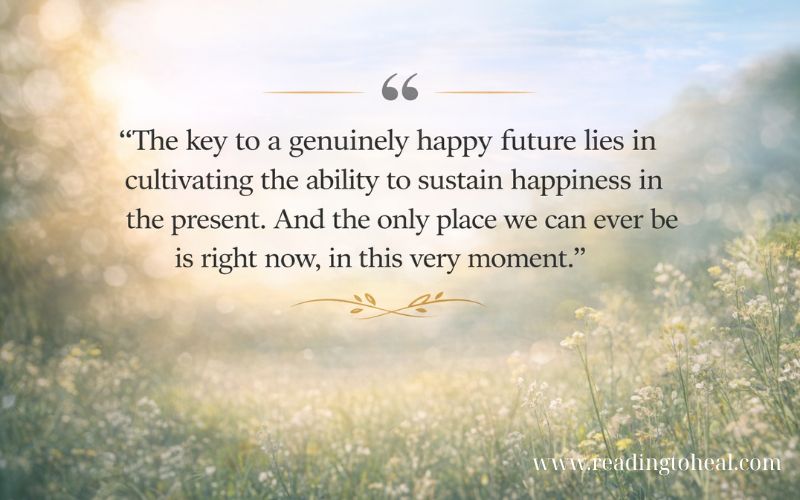
The key to a genuinely happy future lies in cultivating the ability to sustain happiness in the present. And the only place we can ever be is right now, in this very moment.
If the mind constantly regrets the past or dreams of the future, the present moment becomes a form of suffering - and you miss it entirely.
True happiness is the integration of pleasure and meaning. Pleasure represents present moments, while meaning arises from goals that benefit the future.
In other words, you strive for the future while simultaneously enjoying and joyfully experiencing the process of striving.
As expressed in the famous animated film Soul: life is about having a purpose, not living for the purpose alone.
Practices for Building Lasting Happiness
Beyond theory, drawing from his perspective and experience as a scientist, the author of Happier: Learn the Secrets to Daily Joy and Lasting Fulfillment offers practical ways to
Re-examining Your Life Mission
A meaningful mission must be voluntary and focused on realizing your own values - not on pleasing others’ expectations or meeting societal standards.
According to Tal Ben-Shahar, people generally relate to work in three ways:
-
Job orientation: work is a means to earn money, with constant anticipation of holidays.
-
Career orientation: focus on professional advancement, power, and prestige.
-
Calling orientation: work itself is the purpose of life. People work because they want to, regardless of harsh conditions.
Only those in the third group are able to integrate work with life purpose. When you strive for your own values and personal mission, your daily life becomes rich and joyful.
Applying the MPS Method
In the next section of Happier: Learn the Secrets to Daily Joy and Lasting Fulfillment, Dr. Shahar introduces the MPS method for finding work that truly suits you:
-
M stands for Meaning
-
P stands for Pleasure
-
S stands for Strength
These correspond to three questions:
-
What work is meaningful to me?
-
What activities bring me joy?
-
What are my strengths?
What you need to do is find the intersection of these answers to realign your life direction. This method can help you find work that brings genuine happiness.
Redesigning Your Job
Ask yourself: Am I happy with my current job?
Depending on your situation, you can choose to make changes at a macro level (quitting to find a more suitable job) or at a micro level (adjusting your current role).
Specifically, you can set clear goals and seek challenges within ordinary tasks in order to achieve a state of flow, as described by the author of Flow.
Finally, we must consider whether our actions deprive others of their right to pursue happiness. Harming others ultimately means destroying our own happiness.
Happiness can only grow on a foundation of harmony and mutual benefit with the surrounding environment.
The Message of Happier
Through Happier: Learn the Secrets to Daily Joy and Lasting Fulfillment, Tal Ben-Shahar conveys a clear message: live mindfully in the present and find a vocational mission that develops your inner values.
Advice from Reading To Heal: begin by simplifying your life - practice subtraction. Remove goals and tasks that leave you no time for yourself.
As psychologist Tim Kasser once said:
“Time affluence brings more happiness than material affluence.”
Protect your time for what truly matters and brings you joy. Let go of the chase for money and fame, and redirect your focus toward intrinsic goals that offer genuine meaning and happiness. On the journey toward your goals, you can always enjoy joy in each step.
This is the secret to living truly and enduringly happy.