Flow - How to Live and Give Your All in Mindfulness
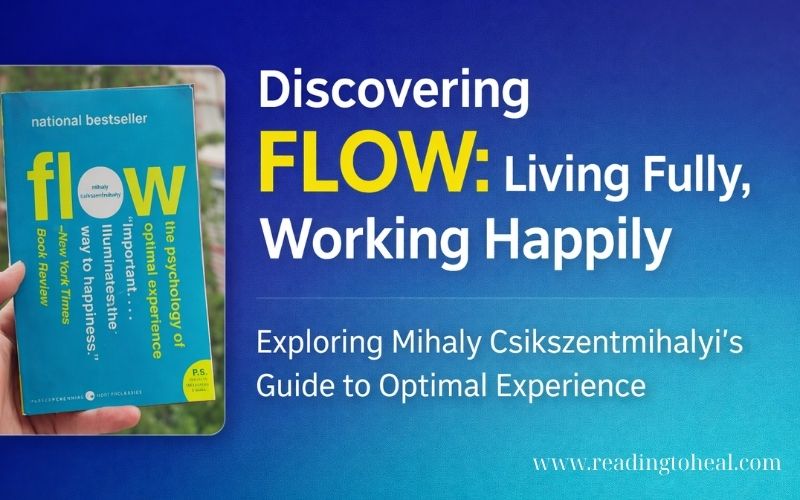
If you have had such experiences, then you have touched what is called Flow (the optimal experience, the flow experience), as described by psychologist Mihaly Csikszentmihalyi in his book Flow.
What Is the Flow Experience?
According to psychologist Mihaly Csikszentmihalyi, the state of losing oneself while working or relaxing is precisely the optimal experience - Flow.
He explains the concept of Flow in detail as follows:
“When a person is fully concentrated on an activity, a sense of deep enjoyment and fulfillment emerges. At that moment, every action and thought flows smoothly, like a stream of water. Human potential is brought to its highest point. Flow is the catalyst on the path of personal development. When you focus intensely and enter Flow, you encounter an immensely powerful version of yourself.”
For this reason, if you are on a journey of returning to yourself and developing personally, Flow is truly a suitable book. It is not only an outstanding work of psychology or a lifelong research achievement of Mihaly Csikszentmihalyi, but also a genuine healing book - one that helps you understand the inner strength within yourself more clearly.
Recommended Reading
Ways to Experience Flow
Surely, all of us have experienced moments of “losing ourselves” like this. Yet once the mind interferes, we return to the image of a person exhausted by work and life. So how can we experience the optimal state as Mihaly Csikszentmihalyi describes? First, read Flow, and you will recognize several crucial guidelines.
The First Factor: Complete Focus
According to Mihaly Csikszentmihalyi, we must truly concentrate in order to enter the optimal experience - Flow. This is illustrated by the first story in Flow.
The story takes place in a factory where there was a rather shy, quiet worker who was not highly regarded. Everyone believed his abilities were quite ordinary. To test this, the factory manager arranged for him to work next to another worker who was outstanding at the same position.
At the time, the excellent worker appeared to be extremely productive, so everyone assumed that he was doing the shy worker’s share of the work as well. But that was not the case. It turned out that the most productive person was actually the shy worker. What made him outperform his colleague was his complete and wholehearted focus.
Mihaly Csikszentmihalyi explains that when we concentrate intensely, the human mind possesses an incredibly powerful source of energy. However, when we do not know how to control and direct this mental energy, we are easily swept away. Our minds constantly fall into a state of chaos and distraction, and automatically withdraw when facing difficulties.
In the past, I was someone who found it very hard to concentrate. If there was noise around me, I had to isolate myself in a quiet corner to work or read effectively. However, after moving into a new living, studying, and working environment, I no longer had large blocks of uninterrupted time during the day. Studying while working, and at the same time trying to read books and write content, all became major challenges. I believe many of you have encountered similar challenges, because modern life has fragmented our time into countless small pieces.
Therefore, training the ability to concentrate deeply at any moment is truly important. The way I do this is through mindfulness practice: mindfulness while eating, mindfulness while walking, mindfulness while brushing my teeth, mindfulness while getting dressed. Any daily activity becomes, for me, an opportunity to connect more deeply with each surrounding moment.
Mindfulness means bringing our awareness fully into every action we are performing in the present moment. You can explore the books of Zen Master Thich Nhat Hanh to gain a deeper understanding and practical guidance.
Once you develop the habit of being attentive and present in daily activities, you will gradually find it easier to focus fully on your work at any time. And when you can concentrate completely, you will then experience the joy of losing yourself - the Flow experience.
The Second Core Factor: Wholehearted Engagement
Beyond cultivating deep concentration, the second core factor for experiencing Flow is the ability to engage wholeheartedly in one activity. The question then becomes: what kind of activity allows us to do that?
The author of Flow points out that the Flow state occurs only when you are engaged in a task that is neither too difficult nor too easy. Because if it is too difficult, you will give up; if it is too easy, you will feel bored.
These are activities you can control with ease, where actions unfold naturally and smoothly. During the process, you feel comfortable rather than irritated. Upon completion, you receive immediate feedback and experience satisfaction. This satisfaction is not a superficial feeling like “Oh great, I’ve finished my task,” but a deep sense of fulfillment that arises from within.
This means that the work you are doing must harmonize your mind and your actions. It should not create inner conflict. For example, if you force yourself to make a lot of money through a job that, deep down, you do not truly accept - if you dislike the way it operates to persuade people to spend money on your company’s products - then even if you achieve outstanding performance metrics, you will not experience deep satisfaction. You only gain temporary pleasure from dopamine release, which drives you to strive for higher status and greater recognition. Yet after reaching those goals, you will still feel empty.
As Mihaly Csikszentmihalyi writes:
“Chasing excessive greed will never help us enter Flow. Therefore, choose a task that is not driven by desire, one that is challenging but not overly difficult. When you can engage wholeheartedly in such work, combined with deep concentration, you will feel as though time disappears, you forget yourself, and you seem to be carried along by a current. At that moment, you are experiencing Flow.”
Discovering Flow in Solitude
Another approach suggested by Mihaly Csikszentmihalyi in Flow is discovering Flow within solitude.
After studying thousands of cases, he concluded that a person who knows how to find Flow in life can discover joy even in the most desperate circumstances.
The book describes the case of a woman in her sixties. After her husband passed away and her children grew up and lived their own lives, she lived alone on a remote island. The impermanence of life and death, combined with the stillness of loneliness, made her feel utterly helpless. She often sighed or burst into tears while missing her husband and children. Endless nights passed without sleep, and every minute felt painfully long.
Later, to ease her pain, she began reading all kinds of books left on her bookshelf, then writing or drawing her thoughts. Unexpectedly, the richness of these stories and perspectives led her into a vast inner world. In this world, she could forget time and overcome sorrow. These profound experiences rekindled her passion for life.
In addition to reading and writing, she planted flowers, grew trees, and raised livestock near her home. She even wrote humorous stories she created herself on signboards or painted signs to guide visitors to her house. She no longer indulged in wandering thoughts or became overwhelmed by negative emotions. Her spirit grew stronger day by day. Although she still lived alone, she no longer felt empty or helpless, because Flow continuously filled the gaps in her soul, helping her avoid unnecessary emotional depletion. Moreover, Flow allowed her to experience a life of intellectual and spiritual growth in the later stage of her life.
Thus, if you are lonely or living alone, this is still an opportunity to experience Flow. As Schopenhauer once said: “Only when a person is alone can they truly be themselves.” When we are alone, we gain the chance to quiet our minds, focus on one thing, and enjoy genuine joy. This solitude is a form of high-quality loneliness.
Other Ways to Experience Flow
However, in today’s age of information overload, most people do not know how to be alone, let alone enjoy solitude. When alone, many immediately reach for their phones, watch movies, or play games to fill the inner void. The mind becomes restless with endless anxieties.
According to the author of Flow, the main reason is a lack of strong inner discipline. Year after year, we become lazier, and mental entropy grows increasingly chaotic. To counteract this entropy, we must focus and embrace solitude by adding richness to life through Flow experiences.
Beyond the methods mentioned above, Mihaly Csikszentmihalyi believes that almost any activity in life can generate Flow, such as mountain climbing, baking, learning to dance, gardening, sewing clothes, or crafting items from recycled materials.
These small hobbies and interests outside of busy daily work become refuges of Flow in your mind, soothing complex emotions and helping you regulate and strengthen yourself.
In addition, the author points out another effective way to experience Flow: appreciating art and increasing physical activity. As we continuously refine our capacity for artistic appreciation, we can more easily enter the Flow state.
For example, listening to music attentively and seriously allows emotional vibrations to resonate through high-quality sound, guiding us into the optimal experience.
Furthermore, physical movement is always an excellent way to reduce stress. When we challenge the limits of our bodies, negative emotions such as boredom, fatigue, and dissatisfaction are released through sweat, leaving the body light and the mind at ease. This makes it easier to enter Flow and lift ourselves out of suffering.
In Flow, the author writes:
“Anyone who can persist through pain and failure will find their life becoming a continuous Flow - a sequence of experiences marked by complete concentration, consistency, order, and the creation of profound meaning and joy from inner order.”
In Closing
After reading Flow, I realized that within each of us there is always a quiet current - a state of losing ourselves in deep excitement and fulfillment. What we need is to unblock this current by setting clear goals, focusing deeply, loving our work, engaging wholeheartedly, and patiently persevering through challenges.
→ Continue reading: 20+ Inspiring Quotes from Flow by Mihaly Csikszentmihalyi