The Consolations of Philosophy: Read This When Life Feels Adrift

History has seen many great philosophers. Although they held different ideas, they all shared one common trait: a devotion to philosophy. Etymologically, "philosophy" comes from the Greek for "Love of Wisdom." This book meets the ordinary person's need to seek wisdom through philosophy. Without a foundation in the subject, reading thick, specialized academic texts can be extremely difficult. Alain de Botton - a talented British writer born in 1969, a Cambridge graduate currently living in London - selected six great philosophers from history and wrote this book so that these six individuals could bring healing to various aspects of our lives. That is why it is titled The Consolations of Philosophy.
Today, Reading To Heal will distill the core essence and add personal details along with practical meanings from this book to help you explore the thoughts and experiences of six famous philosophers: Socrates, Epicurus, Seneca, Montaigne, Schopenhauer, and Nietzsche. It is my hope that when your heart is full of suffering, stress, and anxiety and you don't know what to do, they will help you ease the pain, calmly face and accept the different arrangements of life through various perspectives, and even help you heal and overcome those issues.
How to Live When Lacking Money and Facing Life's Setbacks
Living in this world, we have too many things to "be sad about": from financial disappointments to family sorrows, relationship issues, and work troubles... So, what should we do? We will find the answers in the book The Consolations of Philosophy.
Consolation for the Unpopular (Socrates)
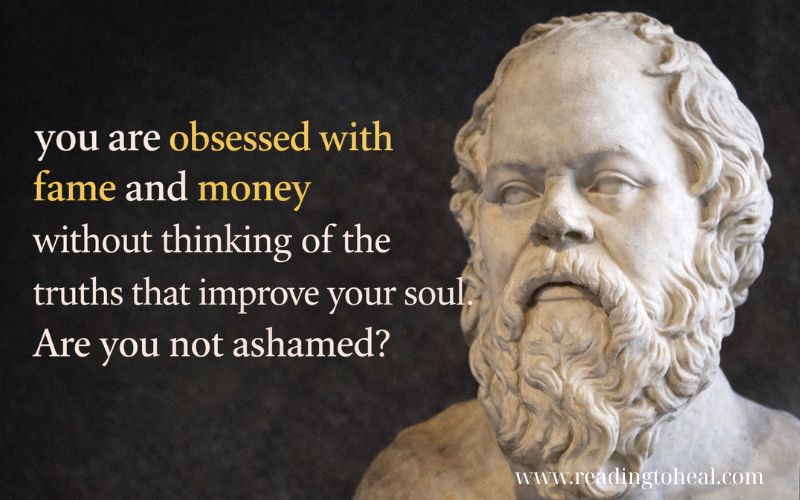
The first philosopher is Socrates. In the spring of 399 BC, three Athenians - the poet Meletus, the politician Anytus, and the rhetorician Lycon - filed a lawsuit against Socrates, accusing him of disrespecting the city-state's gods, spreading heresy, and corrupting the youth. They believed Socrates should be silenced forever by drinking poison. Why was Socrates sentenced to death? It was because he went against the majority.
Every society has its "common sense" - a fixed, powerful, and solid cognitive framework that many follow instinctively, turning it into a social standard. Examples include what clothes to wear, what defines wealth, who to respect, or what tasks to follow. But if someone goes against this common sense - if someone says that what you have perceived all along is wrong - the first reaction of most people is not curiosity about why they are wrong, but rather anger.
Socrates in Athens at that time was no different. Many were angry because he went against their views. This man, born in 469 BC, spent his life walking barefoot in a simple cloak year-round and had a fierce wife. Every day he walked the streets, and whenever he met someone, he would question them persistently about the meaning of their life. This was how he practiced philosophy and helped people understand the truth of life. Yet, these things went against the grain for many people at the time.
On the day of Socrates' trial, the jury consisted of 500 people. The prosecutors used flowery, flashy language to make weak arguments appear victorious and to convict Socrates. However, he remained unusually calm. The court gave him the chance to renounce his truth in public, but he chose the truth he believed in rather than following the crowd.
He spoke powerfully before the court:
"As long as I breathe and have my faculties, I will never stop practicing philosophy. I will never stop advising you, and I will not stop explaining the truth to every person I meet. Therefore, gentlemen, whether you release me or not, it will not change my behavior. Even if I must die, I have no regrets. I want to advise each of you to think less of practical benefits and more of the happiness that comes from the spirit and morality. I will continue to speak as usual. My good friends, you are Athenians, from one of the greatest cities in the world, famous for wisdom and power, yet you are obsessed with fame and money without thinking of the truths that improve your soul. Are you not ashamed?"
In the end, 220 jurors found Socrates innocent, but 280 voted him guilty. Socrates remained calm, his expression unchanged, his hand steady as he took the cup of poison and drank it dry. Socrates, of course, admitted that we can be wrong and that your opinion can be doubted, but the important thing is that he offers you a philosophical perspective to live as yourself when being denied, rejected, and untrusted. That is: Never use the disapproval of others as the measure of your thoughts and lifestyle.
What we should care about is not the number of people who oppose us, but how well-founded their opposition is. As the author says: "True dignity never comes from the majority but from a just argument."
Whether your thinking is justifiable and logical is what proves your human dignity, not how many people support or praise you, nor how long an important person of high status has believed in you. Only irrefutable assertions are correct; that is the truth. You should be steadfast.
You will see this philosophy can be applied when working and interacting with society. If you hear a harsh criticism of your work performance and burst into tears, or hear a reproach about your appearance and get angry, it might be that you still believe your worth is largely based on the recognition of others.
You still care about whether you are liked by everyone, how to get promoted, or how to be admired. You are still holding onto the gossip, ridicule, or criticism of others as a guide for yourself. If you are still suffering and confused like that, then Socrates' story can be a source of inspiration for a beginning of healing, helping you stay on the right track.
Start by constantly strengthening yourself, expanding your field of awareness, and looking at everything from a higher dimension; only then can you be steadfast internally and not lose the truth in your heart.
Further Reading
If Schopenhauer speaks to you through his darker, more sober view of happiness, you may want to explore this reflection on his philosophy of inner life and quiet joy:
Arthur Schopenhauer’s “The Wisdom of Life”: Finding Happiness in the Shadows
Consolation for Not Having Enough Money (Epicurus)
Then, time moves to 341 BC, on the island of Samos in Greece, where a child was born: Epicurus. He was a philosopher of hedonism. This school emphasizes that the starting point and final goal of life is pleasure. Humans live for joy.
But when hearing the word "hedonism," many people let their imagination fly high. People said he was a glutton, a debauchee, living in a disgusting environment of excess. They claimed he ate so much every day that when he was too full, he would vomit just to continue eating. These were all rumors. As you know, rumors have wings and spread powerfully - so much so that when you look in the Oxford English Dictionary, you find the word "Epicurean." For example, saying "This meal is very Epicurean" means it is delicious and luxurious. The word Epicurean symbolizes enjoyment and luxury.
In reality, Epicurus lived very simply. He drank only water and no wine. A meal of bread, vegetables, and a handful of olives was enough. His list of needs for pleasure was extremely minimal yet capable of bringing profound joy, consisting of three things:
-
Friendship: For Epicurus, to have happiness, one must have friendship. He said: "Of all the things which wisdom provides to make us entirely happy, much the greatest is the possession of friendship." Before eating or drinking, think carefully about who you want to eat with, not what you eat or drink. Because eating without friends is no different from being a wolf or a lion. His founding of a school of philosophy was also to be with friends who shared the same values and pursued simple happiness as he did.
-
Freedom: The freedom Epicurus proposed is similar to the freedom I once shared in the video about the book "Walden" - living alone in the woods. The author Thoreau worked only six weeks to earn enough for a year of living and then stopped. No one could take away his remaining time. He just sat by the lake reading, walking, playing, listening to birdsong, and observing nature. To him, this was true freedom. Looking at us today, we spend too much time trying to earn more money, but in doing so, we lose a lot of freedom.
-
Thought: This means that if you only have simple thoughts and do not pursue deep goals - if you don't read many books, don't understand nature, yourself, and life - then your freedom or friendship will be superficial. Therefore, you can never truly feel what joy and happiness are. So, the most important thing is to train the ability for deep reflection.
-
Natural and necessary desires: These are the most basic needs in life that we all must have. For example, the need for food, shelter, clothing, freedom, friends, ideas…
-
Natural but unnecessary desires: For example: already having a house but needing a bigger one; having a car but needing a fancier one; having food but needing gourmet delicacies. These are truly unnecessary.
-
Unnatural and unnecessary desires: Specifically, the pursuit of status and fame. Like when your original intention was to share something on social media, but as you continue, you become obsessed with the goal of being famous and having many people know you. These things are illusions because they do not bring happiness but only create more burdens.
Thus, you will see that reshaping your desires will help you heal your own life.
Epicurus helps you realize that we can completely set aside all the sorrow and frustration of feeling like we don't have enough money by seeing through one question:
"Why do people in today's society always find ways to pursue more things, only to suffer when they don't achieve them?"
It is because we do not truly understand our own needs. In reality, what you need is not that complicated; it only includes freedom, connecting basic needs of life - that is enough. Simplifying everything will help you be happy.
But because you don't understand what you truly need, a superficial inner self and a wisdom lacking depth will prevent you from understanding what true freedom, friendship, and love are. So, when we have no answer but keep rushing forward, humans will believe that expensive things will help us reach what we desire.
We think that when we achieve financial freedom, we will truly have freedom. We think a fine bottle of wine will help us make friends. We think having a big house and a private car will help us get the ideal spouse... But those things are not your true needs; they are just excess desires. So, after hearing Epicurus's story, do you feel a bit more at peace? With just a bit of bread and some olives, you can truly live a good life.
Consolation for Frustration (Seneca)
Next, in The Consolations of Philosophy, the author takes us from Greece to Rome to meet the philosopher Seneca.
Do you know the tyrant Nero, notoriously cruel in ancient Rome? Seneca was Nero's teacher for five years and an assistant to this tyrant for 15 years. Perhaps the two had a fairly good emotional foundation, yet Nero sent a group of soldiers to Seneca's house and granted him death by suicide. At this moment, Seneca's wife and those around him burst into tears because they mourned him as a talented philosopher and a man of great character. However, Seneca remained incredibly calm and said a famous line: "What has become of your philosophy?"
It was from Seneca's time that the word "philosophy" appeared in Western discourse. Philosophy from the beginning meant serenity and composure. Seneca was a model example of composure. He was one of the most important representatives of Stoicism - one of the four major philosophical schools in ancient Greece. The core tenet of Stoicism is to maintain inner peace in the face of a chaotic, unpredictable, and harsh world.
Seneca experienced the destruction of the decadent city of Pompeii, lived through the reign of Caligula - the most insane, cruel, and debauched emperor in the world - and then faced the tyrant Nero. At age 20, Seneca contracted tuberculosis. Through hard work, he finally survived after six years of battling the disease. But as a result, after Caligula was assassinated, he was caught up in a palace coup and exiled for another eight years.
How could Seneca face such an unbelievably troubled life? He said: "Philosophy has given me life, and being calm through philosophical methods is my minimum payback to philosophy." The core of Seneca's philosophy is that life inevitably involves setbacks. Therefore, everyone must be prepared to receive them.
But let's look back: when facing setbacks, most people just get angry. Just someone speaking loudly and making noise while we are studying, or a car behind us honking incessantly on the road... you will feel an anger that makes you want to go crazy.
Seneca was the teacher of an emperor, living in the powerful aristocracy, yet he believed life could not be perfect. Children not listening, friends turning their backs on you, enemies playing dirty, a lover betraying you, a career collapsing... or even major shocks like an unfortunate accident or a serious incurable illness - to a Stoic, you can still remain calm and feel unharmed even if these things happen at any time. Impermanence happens every day; anxiety only comes from our resistance to impermanence.
Seneca believed the wise person has nothing to lose because they can find satisfaction within themselves. He said:
"I have never trusted Fortune, even when she seemed to be offering me a peaceful life. I set aside all the money, positions, and power she gave me. And the goddess can take them back at any time without disturbing me. I keep a distance from those material things so she can take them away instead of me feeling deprived."
The reason people collapse because of setbacks and failures in life is that we haven't truly kept a distance between ourselves and what we have. This distance is a place where you can be calm even when those things are lost, and it is the limit so you are not mixed and assimilated with material things. Losing a house, a job, a lover, dropping a gold ring, or accidentally breaking a phone screen - if you are still suffering, it means you have been assimilated by material objects.
Therefore, in this section, you will receive healing for your pain through the philosophical method of Stoicism: Always keep a distance from all materials, positions, fame, and relationships you have; be serene and composed before all changes of impermanence.
The Consolation of Philosophy When Life Isn't as You Wish
None of us are perfect, yet we suffer because we seek perfection; we know that joy and sorrow are natural, yet we still hide from sadness to find joy, and thus suffer. To live more peacefully, let's listen to Alain de Botton share more in this book.
Consolation for Inadequacy (Montaigne)

The philosopher Montaigne was born in southwestern France in 1533. He lived in a magnificent castle. At age 30, he inherited the management of his family estate, but he had little interest in this and preferred reading alone upstairs.
He had a famous philosophical view:
"Knowing that one has said or done something stupid is no big deal; because the most important lesson we need to learn is that we are all fools."
Montaigne believed humans have reason and consider themselves smart, but sometimes we are not as happy as animals. Animals know how to take care of themselves better than humans. For example, if a sheep is injured, it will find a corresponding grass to chew and apply to the wound. If a snake is injured, it also knows how to save itself. But if a person is injured, they cannot do that.
There is a story that the philosopher Pyrrho encountered a great storm while traveling by ship. All the passengers were terrified, worried that the fragile ship would break before the violent tide. Only one passenger did not lose his composure and sat quietly in a corner with an incredibly serene face: it was a pig. Do we dare to say that the benefit of having reason helps humans reduce suffering in life?
We elevate reason to the point where we think we can dominate all things, but with knowledge and reason, why can we still not have true peace?
Reason gives humans the ability to judge and perceive, but the price paid for it is very high: it gives birth to conflict, doubt, anxiety, ambition, envy, lies, infidelity, war.... We need to live rationally, but if we over-elevate reason - thinking what we think is absolutely right - it will be the indirect cause of suffering over the flaws and imperfections of life. For example: being obsessed with an unattractive body, obsessed with being less intelligent, low exam scores, low education, or an unimpressive profession.
Montaigne said the biggest fool is the one who cannot accept that they might be a fool. What's wrong with being an imperfect person? After all, we are all fools. We are fools because the physical body always has limitations and greatly affects humans, and no one can escape this heavy flesh. No matter how noble you seem, you still sit on your own butt - that is a witty saying from this philosopher.
Therefore, there isn't much difference between people; those with flaws don't need to feel inferior. All organs of the body from head to toe are equal. We don't need to try to hide a part we don't like, nor do we need to be upset about it. After all, they are just organs of the human body.
Besides, we are also fools because this brain over-elevates reason and the self. Thus, we overcomplicate issues when we see ourselves as weaker than others.
For example: many parents take children's achievements very seriously. Montaigne believed that school grades do not represent intelligence. A person's intelligence is shown in life lessons, in tests from daily life problems, not in books. Human life is inherently one part madness, one part wisdom. Therefore, if we admit our weaknesses, stop being self-conscious about what isn't as intended, and stop boasting about what makes us proud, then by living our own unique "half-wise, half-foolish" way, we will also have a fulfilling life.
Consolation for a Broken Heart (Schopenhauer)
Speaking of sadness, we cannot fail to mention Schopenhauer. He was a philosopher who suffered and was lonely his whole life, receiving countless praises only after he had passed away. Famous people deeply influenced by him include Nietzsche, Freud, Tolstoy, Einstein, and Wagner.
Schopenhauer was born in 1788 in a German city that is now part of Poland. His childhood was both lucky and unlucky. His father was a wealthy, withdrawn businessman, while his mother was an enthusiastic, cheerful person. The two different personalities often argued. Growing up in such a family atmosphere, Schopenhauer was sensitive and melancholic from a young age.
When Schopenhauer was 17, his father committed suicide and left him a large inheritance, ensuring he would never need to work. Later, he was sent to study in England and France. However, during this process, he showed symptoms of depression and daily thought about the suffering in the world. His father's suicide left a massive psychological shadow on him.
Schopenhauer had an incredible philosophical talent. When he was only 30, he published his first work, The World as Will and Representation. This book is very famous today; anyone who likes to learn about philosophy should read it. However, that year, the book he put all his heart and expectation into sold only 230 copies because almost no one could understand it. Indeed, those at the forefront of thought are always lonely. The work he wrote with so much effort ended up piled in a warehouse, which devastated him.
However, he continued to write. Two years later, he taught philosophy at a university in Berlin, but his class had only five students, while Hegel's class next door had 300. Perhaps it was because he was not good at speaking and had a relatively introverted personality. He had an incomplete love affair that flickered on and off with a girl for 10 years. It wasn't until age 63, with his final work Parerga and Paralipomena, that he became known. Two years after that, he was famous throughout Europe, and his previous books became unexpectedly popular. The book he hadn't expected much from caused a sensation. Schopenhauer finally achieved the glory he should have had earlier. But by then, he had long disregarded fame and wealth; he even politely declined the title of Academician of the Royal Berlin Academy of Sciences.
Schopenhauer spent the rest of his life living in seclusion in Frankfurt with his companion, a poodle. He lived to be 72 and never married. His attitude toward love was: love can interrupt serious work at any time, and sometimes even the greatest minds can be temporarily confused by it. It sometimes requires humans to sacrifice health, wealth, status, and happiness. He said love rarely ends well, but why do people still want to love? It's because humans have a strong "Will to Life." That will comes from a force that requires humans to reproduce and maintain the survival of the species in the future.
It can be seen that Schopenhauer speaks about love in a very dull way, but his thoughts are incredibly profound. He realized the process of most people falling in love is actually meaningless. You lie, I lie to you, you are only for you, I am only for me. It is the strong Will to Life that makes each person do such things repeatedly from generation to generation. Schopenhauer was a pioneer in Voluntarism. He believed the Will is higher than Reason. Life is a tragedy and desire is the source of all pain.
His philosophical thoughts seem pessimistic but can make a person extremely strong in loneliness. Schopenhauer's core view is that life basically has no value. Humans rely only on needs and illusions to keep moving. In reality, humans are dedicating their lives to a meaningless existence. He said life is like a pendulum swinging between pain and boredom. When desire is not satisfied, there is pain; when desire is satisfied, boredom is born.
So, standing before such a tragic, painful, and meaningless life, what should we humans do?
Schopenhauer believed a truly wise person should do this: "When digging a lake in the dark, we must try to turn tears into knowledge." This means clearly recognizing the meaninglessness of human life. We need to survive and learn to do one thing: turn pain into knowledge. This is the only way to live a different life and the way Schopenhauer healed his own sufferings. You will see that, after all, thinking is the source of happiness. The richer the inner spiritual world, the happier you will be.
Consolation for Difficulties (Nietzsche)
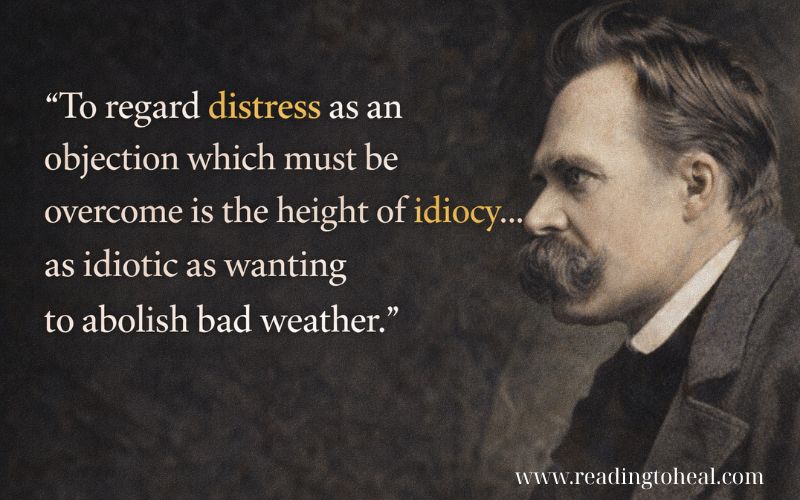
The final philosopher in The Consolations of Philosophy is Nietzsche. What this philosopher brings to us is healing within difficulties themselves.
Nietzsche said:
"To those human beings who are of any concern to me I wish suffering, desolation, sickness, ill-treatment, indignities - I wish that they should not remain unfamiliar with profound self-contempt, the torture of self-mistrust, the wretchedness of the vanquished."
Nietzsche's view is like an upgrade of Mencius. Mencius once said: "When Heaven is about to confer a great responsibility on any man, it first exercises his mind with suffering, and his sinews and bones with toil. It exposes his body to hunger, and subjects him to extreme poverty. It confounds his undertakings. By all these methods it stimulates his mind, hardens his nature, and supplies his incompetencies."
Pain, to Nietzsche, was the indispensable material for building brilliant humanity. Therefore, look at Nietzsche's most famous quote: "What does not kill me makes me stronger." This is the truth and his core argument.
At age 21, Nietzsche went to a bookstore and, driven by some urge, read Schopenhauer's The World as Will and Representation.
From then on, he was influenced by the late philosopher and always believed life was meaningless. But by age 32, Nietzsche underwent a major change. He no longer agreed with Schopenhauer's view and felt the theory of the man he had considered his teacher was impractical and failed to tap into the power of life. This thought came from his trip to Italy, where he had never laughed so brightly. Therefore, he believed life was not entirely meaningless and painful.
And from there, he strengthened his "Übermensch" (Overman) philosophy. The Overman here is not like what we see in movies, but Nietzsche's Overman is a capability that makes life stronger. An Overman in Nietzsche's philosophy is built on four models:
-
Montaigne - whom we introduced above;
-
The great German figure Goethe;
-
Stendhal - author of The Red and the Black;
-
The famous diplomat Galiani.
These people shared common traits: curiosity, a love for art, and the ability to dance and laugh even in the dark.
Nietzsche believed all following pain is based on joy. Because you want to pursue joy, you must be brave enough to endure pain. He said suffering and happiness are closely linked. Whoever wants as much as possible of the one must also have as much as possible of the other. You can choose one of two: achieve the least possible joy to not suffer much, or experience as much suffering as possible to receive the value in return of enjoying an inner joy that few have known until now. If you choose the former, wanting to reduce the level of suffering in life, you must also reduce the human capacity for pleasure.
In addition, Nietzsche had a hobby of mountain climbing. He rented a wooden cabin at the foot of a mountain and frequently climbed to the peak. He especially liked the air up there and felt mountain climbing was a difficult but interesting process. It tests humans and creates inspiration. But his family circumstances were also extremely difficult. While Schopenhauer lived without financial worry due to wealth, Nietzsche was very poor - so poor he couldn't afford bread and nearly died of hunger.
Nietzsche proposed to many people, but no one wanted to follow him. Later, Wagner, Nietzsche's friend, advised him to marry a wealthy woman. But Wagner did not know that the woman Nietzsche secretly loved was Wagner's own wife. Thus, Nietzsche's love life was never as intended.
And in 1889, Nietzsche fell into a state of collapse. Seeing a horse being beaten on the street, he suddenly ran to embrace it and said: "I suffer so much, my brother." Afterward, he was taken to an asylum in Germany, cared for by his mother and sister. Eleven years later, he passed away at age 55, ending in madness.
Nietzsche's life and the core of his philosophy are captured in this quote of his, which serves as a reminder to you:
"To regard distress as an objection which must be overcome is the height of idiocy... as idiotic as wanting to abolish bad weather."
In life, we will certainly encounter difficulties, but it is difficulties that will be the motivation for you to exert your strength. Do not try to avoid every difficulty nor fear suffering, because avoiding it also means you are avoiding all opportunities for the vitality of life to shine.
Concluding Words on The Consolations of Philosophy
There we have it - six stories of six philosophers from Alain de Botton's The Consolations of Philosophy. It is hard to fully understand their thoughts and philosophical views through this thin book alone. What I hope is that these philosophical ideas can provide you with a bit of inspiration, make you feel the interest within them, and offer useful guidance. Who do you like? From whom did you receive healing? What do you need to do next to think more deeply and enrich your inner self? If you have this desire, you can absolutely read more books about that specific philosopher.
Ultimately, you will see that philosophy is not just a consolation or a healing, but above all, it is the intellect and wisdom of life. It allows you to face all difficulties, lack, dissatisfaction, and suffering. The wound within you is exactly the opportunity to discover your own strength through wisdom.