Trying, for once, to review the Tao Te Ching
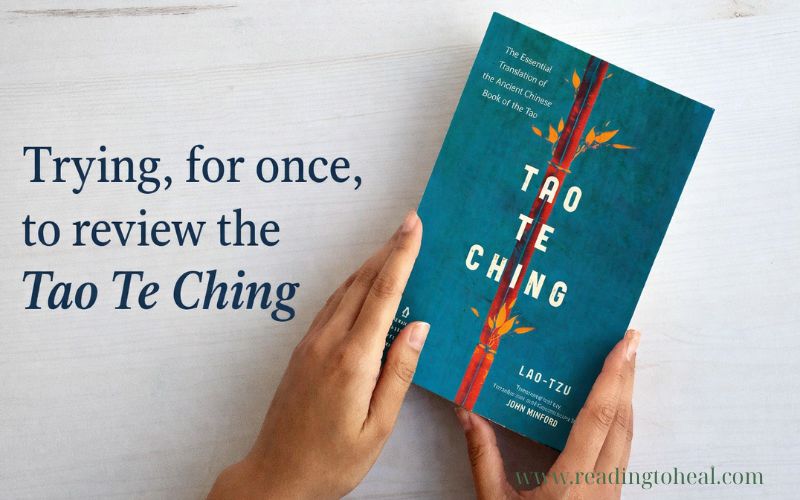
Today, Reading To Heal tries, for once, to write about this special book. Because, in truth, this is a book that cannot be reviewed or evaluated - it goes far beyond such attempts. Still, within the narrow limits of language, we attempt to speak of the essence that Lao Tzu left behind.
Lao Tzu and the Tao Te Ching
Written more than 2,500 years ago during the turbulent Eastern Zhou period of China, the Tao Te Ching, consisting of 81 concise chapters, is not a philosophical or religious text in the conventional sense.
Rather, it is a map for those who seek balance and stillness in a world of constant chaos. Lao Tzu, a legendary figure whose historical existence remains debated to this day, is regarded as the founder of Taoism. Although some Western scholars question whether he was merely a mythical figure, the teachings of the Tao Te Ching have endured for millennia, transcending borders and eras, influencing millions of people.
The story goes that Lao Tzu was once an archivist at the imperial court. Disillusioned with the moral decay of urban life, he decided to leave and travel westward. Upon reaching the Hangu Pass, the gatekeeper begged him to leave behind his teachings before departing, and from that moment, the Tao Te Ching came into being.
This book is a deeply moving farewell gift, a final glimpse of a sage upon life and all things. It is not a bitter renunciation, but a jewel of wisdom distilled into 81 chapters.
The Tao Te Ching defies easy classification. It is philosophy, poetry, a guide to living, and a treatise on governance - all at once. Above all, it is a mirror reflecting ourselves: our desires, our fears, and the entanglements we create. Through short, poetic, and paradoxical passages, Lao Tzu does not preach or command; he gently points to the “Tao” - a principle beyond words, both the source and the pattern of everything that exists.
From the Tao, he speaks of Te (virtue), humility, moderation, and compassion - qualities that withstand the test of time.
The fundamental nature of the Tao
From the very opening of the Tao Te Ching, the reader is confronted with a profound philosophical shock:
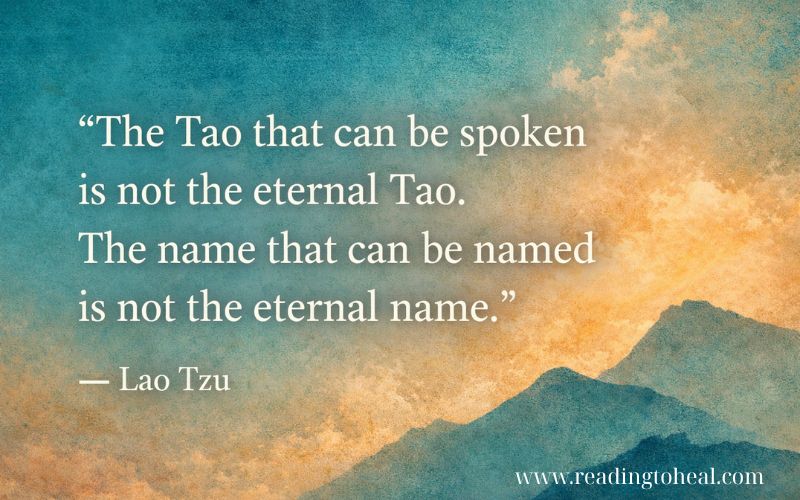
“The Tao that can be spoken is not the eternal Tao.
The name that can be named is not the eternal name.”
A Tao that can be expressed in words is not the eternal Tao. A name that can be named is not the eternal name. With this opening line, Lao Tzu shatters the illusion that wisdom, reason, or ordinary language can grasp the Tao. It is a deeply paradoxical move: using language to declare the inadequacy of language, writing a book to affirm that what is written is not absolute truth. Yet within this paradox lies a profound wisdom that forces us to move beyond definitions.
Further reading:
If the Tao cannot be fully spoken, perhaps it can be quietly approached through its words.
You may also explore a carefully curated collection of timeless wisdom in The 100 Best Tao Te Ching Quotes from Lao Tzu
So what is the Tao?
Many translate Tao as “the way” or “the principle,” while others choose to leave it untranslated, as no word can fully capture its meaning. Try to imagine the Tao as the most fundamental principle of the universe, the creative and sustaining force of all things, the natural law that governs everything without intervention.
Lao Tzu describes the Tao with striking imagery: the Tao is empty, yet its use is inexhaustible. Like a vessel whose value lies in its emptiness, or a room made useful by the space within its walls. The Tao is the “non-being” that gives rise to all “being,” absence that creates presence.
In Chapter 25, Lao Tzu writes:
“There is something formless yet complete, born before heaven and earth; silent and empty, standing alone and unchanging.”
The Tao is not a personal creator deity, but a spontaneous process that requires no control. Another key characteristic is its nurturing quality, likened to a mother whose energy never runs dry, who gives without coercion.
Humility as the core
In Chapter 8, Lao Tzu advises that the highest goodness is like water. Water benefits all things without competing; it dwells in places most people avoid. It is the softest and most yielding, yet it can penetrate the hardest rock. Because the sea lies lower than all rivers, it becomes the king of a hundred streams. This is a lesson in strength through softness, in victory through yielding.
Lao Tzu also criticizes humanity’s tendency to overcomplicate everything. The more laws there are, the more criminals appear; the more rules, the more violators. Simplicity is the key to harmony.
The most important paradox is wu wei - action through non-action. This is not laziness, but action that arises from such deep harmony with nature that it becomes effortless, like a skilled swimmer flowing with the current rather than struggling against it.
Practice and the power of Te
If the Tao is the foundation, then Te is the way the Tao naturally manifests in behavior. Te in Taoism is not an imposed moral code. It carries the meaning of inner power, the natural expression of true nature. When a tree grows according to its nature, that is Te. When a person lives authentically, without pretense, that too is Te.
Lao Tzu states:
“The Tao gives birth to all things, nurtures them, sustains them… creates without possessing, acts without expectation, guides without interfering.”
Te does not arise from imposition or control, but from letting go.
In Chapter 38, he distinguishes: “The highest Te does not cling to Te, and therefore truly has Te. The lowest Te never lets go of Te, and therefore lacks Te.”
A person of genuine virtue does not even think about being virtuous; they simply live. Those who constantly display their goodness have not yet attained true Te, because it is no longer natural.
He lists three treasures: compassion, frugality, and not daring to be ahead of the world. Compassion gives rise to true courage - the willingness to sacrifice for others. Frugality leads to generosity, because nothing is wasted. And humility is the foundation of leadership. Te also calls for a return to a childlike state: soft, flexible, open, and fully present - contrasting with the rigidity of adulthood.
The power of Te lies not in domination, but in nurturing and transformation. A wise person is one who conquers oneself and knows contentment. Contentment does not mean having much, but knowing that what one has is enough.
Living in accordance with the Tao in society
The Tao Te Ching also offers guidance for both individuals and leaders. In governance, Lao Tzu famously said:
“Governing a great state is like cooking a small fish.”
When cooking a small fish, if you turn it over too often, it falls apart. Governance is the same: the more interference, the more natural harmony is destroyed. The best leaders are those who govern the least, so quietly that when everything is accomplished, the people say, “We did it ourselves.”
The resilience of society lies in its flexibility, like water. Systems that are too rigid often break when circumstances change, while flexible systems that know how to yield endure.
Lao Tzu believed that social change must begin with the individual. World peace begins with peace in the heart. Without inner transformation, all structural reforms remain superficial.
The universe is governed by the interaction of Yin and Yang. Harmony is achieved when these forces remain in dynamic balance. The wise person avoids extremes and embraces the middle path. Simplifying life frees us from the burdens of possession and anxiety.
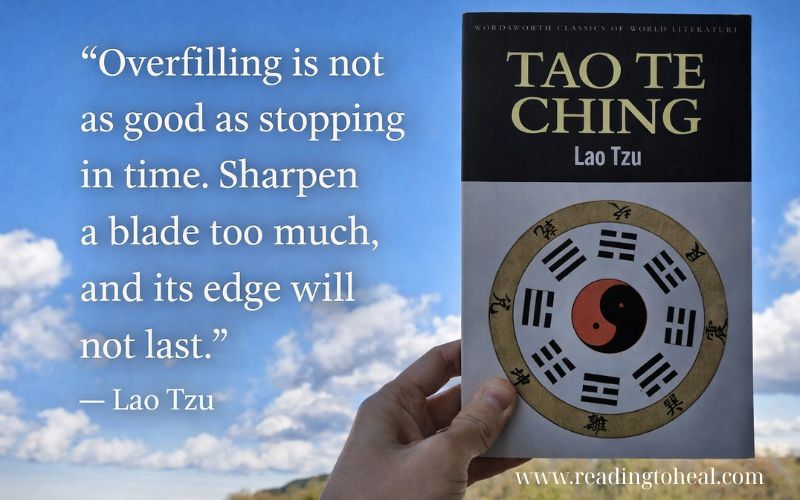
Living in accordance with the Tao also requires awareness of death and impermanence. Lao Tzu does not avoid death, but accepts it as part of the cycle of life. Only when we stop clinging desperately to life can we truly live fully. He also warns against excess: “Overfilling is not as good as stopping in time. Sharpen a blade too much, and its edge will not last.”
A wise person knows when to stop.
Contemporary reflections from the Tao Te Ching
The Tao Te Ching is not a book to be read once and set aside, but a lifelong companion. Though written 2,500 years ago, it remains deeply relevant to modern society - where people are surrounded by pressure to acquire more and to complicate everything.
Some critics argue that Lao Tzu’s philosophy is too passive. In reality, he does not teach submission to oppression; he teaches wise action like water. Water is nonviolent, yet it can wear down stone. The withdrawal he speaks of is not retreating to the mountains, but a psychological withdrawal from competition and ambition within society itself.
In business, the Tao Te Ching teaches servant leadership. In psychology, it resonates with the state of Flow that Reading To Heal has discussed in a previous article. In ecology, it reminds us that humans are part of nature. The greatest value of the book lies in its ability to change how we see ourselves: we are not isolated entities, but inseparable parts of the universe.
Ultimately, the Tao Te Ching does not promise wealth or power; it promises peace and true freedom. The Tao is not somewhere far away - it is always right within you, waiting to be recognized. The Tao that can be spoken is not the eternal Tao, so do not cling to words; let it permeate you and transform you naturally.