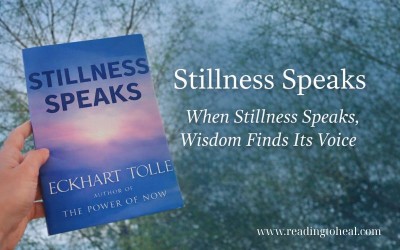
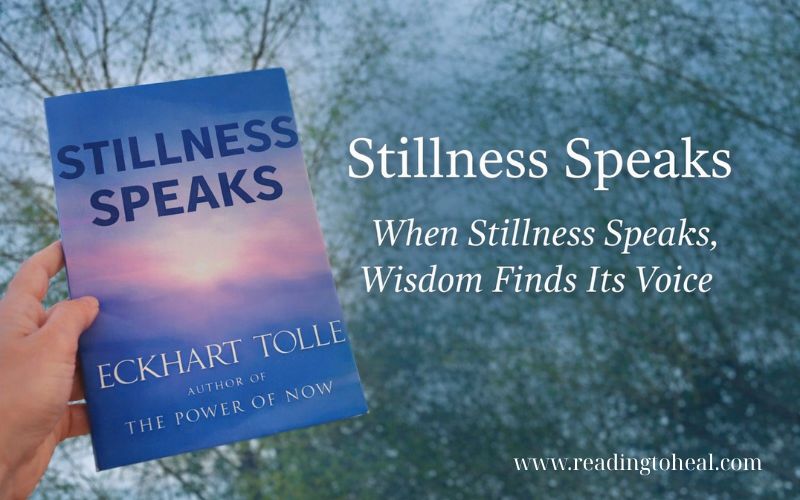
Stillness Speaks - When Stillness Speaks, Wisdom Finds Its Voice
The famous French philosopher Blaise Pascal once said: "All of humanity's problems stem from man's inability to sit quietly in a room alone."
It is not hard to see that in today's modern society, everyone is lost in a vast and boisterous world, busy with the whirlwind of a bustling and promising life. Everyone is occupied with filling their own lives with expectations of a bright future ahead. Everyone hopes that by following this hectic flow, we will find the happiness of our lives.
Hardly anyone chooses to slow down or remain still long enough to understand that this life is like a labyrinth inherently filled with chaos. The more you try to plunge into this flow of disorder, the more you lose your footing within it - trapped in gains and losses, superiority and inferiority, struggles and snatching, and addictive pleasures meant to fill the endless void in the heart. And then, sorrow, exhaustion, and suffering remain lurking, clinging to your back.
Just as in the book Siddhartha, the author wrote:
Hardly anyone chooses to slow down or remain still long enough to understand that this life is like a labyrinth inherently filled with chaos. The more you try to plunge into this flow of disorder, the more you lose your footing within it - trapped in gains and losses, superiority and inferiority, struggles and snatching, and addictive pleasures meant to fill the endless void in the heart. And then, sorrow, exhaustion, and suffering remain lurking, clinging to your back.
Just as in the book Siddhartha, the author wrote:
"Most people are like a falling leaf, which alters and eddies through the air and finally stumbles to the ground."
This life is inherently temporary, yet few are willing to face their own hearts to find the inner stillness. Everyone evades it in every way possible to avoid facing their own soul.
We spend most of the decades of our lives looking outward, fluctuating frantically with the pleasures of the world, walking headlong according to social programming without ever looking up to awaken, only to lose connection with ourselves, with our true nature, and lose our own roots. Ultimately, there is only the shock before the moment of returning to the dust.
Zen Master Linji said: "Walking on earth is a miracle," meaning that the very fact we are alive and walking on this ground is already a miracle. Yet, humans struggle for decades searching for miracles, happiness, and joy in some far-off place. If you can grant yourself silence, and let your mind be still enough, true joy will manifest, wisdom will speak, and life will truly bloom according to the essence to which we belong.
But we have lost our stillness. Today, through the book Stillness Speaks by Eckhart Tolle (author of the two famous books The Power of Now and A New Earth), I hope that the messages the author sends to each person can ignite the motivation within you to find stillness again - your own true nature.
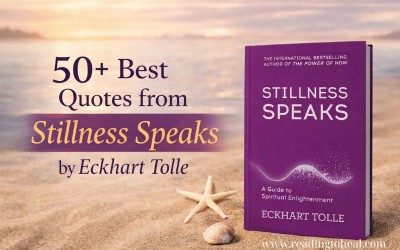
If you’re looking for the most powerful insights from the book, explore our curated collection of 50+ best quotes from Stillness Speaks.
Get Your Free Stillness Speaks Audiobook ($0.00)
30-day free trial. Cancel anytime.
Stillness so as not to be carried away by the mind
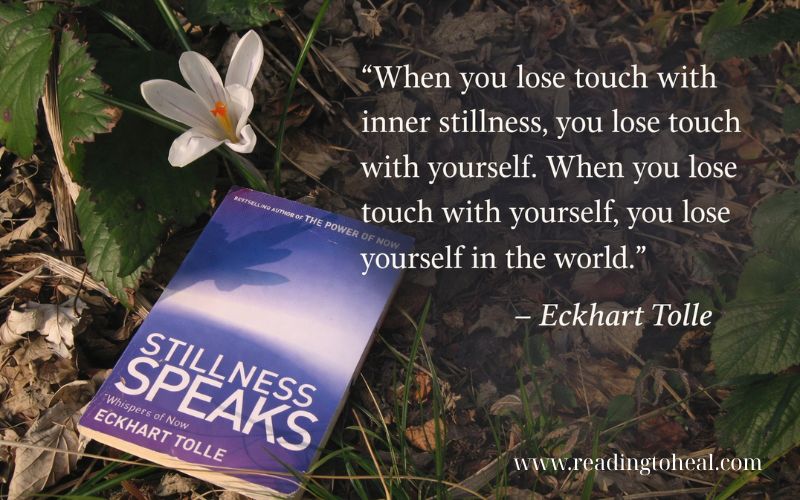
Eckhart Tolle says:
"When you lose touch with inner stillness, you lose touch with yourself. When you lose touch with yourself, you lose yourself in the world."
Suffering created by ourselves
Most humans lose themselves in the world of form, in the prison of unintentional thoughts and chronic fears, binding themselves to the past and sometimes dragging themselves into the future. Our mind is no different from a labyrinth - easy to enter and difficult to exit - eventually falling into suffering and despair, feeling that this life is truly a sea of sorrow. But the harshest reality is that this sea of sorrow is created by ourselves.
In the book Stillness Speaks, there is a passage:
"It is all because of the chronic human malady of being drawn into idle, fearful thoughts in the mind and losing the inherent stillness."
These streams of thought have an extremely powerful momentum, easily sweeping you away from early morning until late at night. An endless stream of reflection: How to escape this high-pressure job? How to earn more money? How to make work go more smoothly? How to have more time for the children? How to take better care of parents?... Thousands of bullet points surround you from the moment you wake up until you go to sleep; even at night, you dream of them like an obsession.
Sometimes you want to run away from reality, away from everything present here because you are truly saturated with exhaustion. We look for ways to relieve it: scrolling through phones, watching TV, traveling, eating... only to finally collapse exhausted with the phone in hand, haggard after trips of eating and drinking, and then continuing that cycle.
We forget that the moment of stopping, of being still in the heart to find balance in the soul, is the best way to regenerate energy - not those parties we imagine will relieve stress but actually wear down our energy and exhaust our minds. Many people turn to addictive substances and stimulants to relieve tension, only to bitterly realize they have become dependent on and bound by them.
Life is not just about worries; sometimes we encounter unpleasant events. Once again, the mind begins to interpret our lives through perceptions driven by resistance to reality: "I feel so much pain because he betrayed me," "I don't want an ending like this"...
Thus, we immerse ourselves in the feeling the mind believes in: the feeling of suffering. An investment loss that leads a person into debt might make them cry out: "Why am I so unlucky?", "Why did this happen to me?" and the mind believes that life is completely dead-locked, with no way out. When parents pass away, children believe this pain makes it impossible for them to live, that this pain will never fade in a lifetime.
Eckhart Tolle says:
"Your suffering is not ultimately caused by the difficult situations you encounter, but by the very negative conditions in your own consciousness."
In truth, betrayal is merely a person's choice, and it does not force you to live in suffering forever just because of someone else's decision. Adverse life circumstances cannot make you lose the joy of living. Illness may cause physical pain, but it cannot make you lose the joy in your soul. Losing a child is perhaps the greatest pain of a human life, but ultimately, it is still the pain of the mind.
The author also says: "There is no other pain than the pain of the mind." Only the thoughts in your mind make you uncomfortable and in pain that never ends. As soon as your mind stops resisting reality, stillness will bring you into the realm of inner peace - where life becomes one, where pain will be healed.
No separate self from the world
The mind not only has the characteristic of resisting the present, but it also always wants to strengthen one's ego. Many people are described as having a "big ego," yet the nature of a sky-high ego is actually extremely fragile.
Because it is so fragile, it is always fearful and full of desire: fear of a future of poverty, fear of lack, contempt, fear of being betrayed - hence the desire for money, fame, lust, and the desire to dominate and control others. The ego always wants to be superior in competition: "She is wealthier, more educated than me, married a more psychological husband than me"... Your ego will feel at a loss and give rise to envy. Even when there is nothing left to be superior in, the ego begins to prove its uniqueness through its unhappiness.
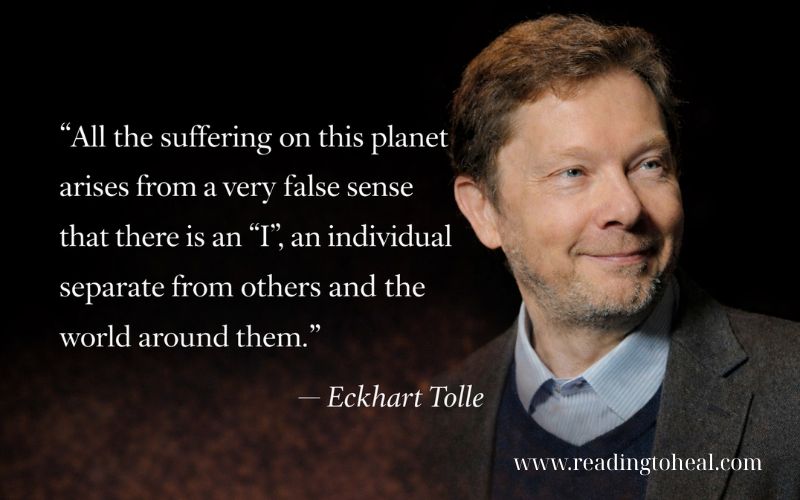
In Stillness Speaks, there is a sentence:
"All the suffering on this planet arises from a very false sense that there is an 'I', an individual separate from others and the world around them."
You will live only knowing how to cling to the small, fearful, and pitiful ego in your own mind. When you consider your ego, your "I," as everything, as separate, and the world in you only revolves around this ego, suffering will sooner or later surround you and those around you.
Stop identifying yourself with streams of thought
Therefore, stop identifying yourself with the thoughts and emotions in the mind. Be alert and still to recognize them, truly accept them, and look deeply into them to know the root cause of the problem to solve it.
Do not judge or label anyone or anything as good or bad, should or should not. Calmly accept, calmly observe; only then can you gradually control the long-standing turmoil in the mind and whittle away the ego that lives on conflict, disagreement, and a love for opposition.
Only stillness in the heart can wake you up from the dream of the mind, making your perception larger and more encompassing of this life. The world out there is immense and vast, while you - the ego in you - is too small. Breaking this narrow vision, with no separate self, all worries and suffering will also dissipate. You will find your way back to your true nature - where life is eternal, where joy is everlasting.
Stillness to find yourself
Perhaps you also see that living in this world, whether you succeed or fail, whether you are healthy or sick, whether you are educated or uneducated, whether life is poor and difficult or rich and prosperous, is an important thing?
But it is only important in a relative view.
The most important thing is to find the true nature
From an absolute perspective, all that you consider important, strive a lifetime to achieve, sacrifice and exchange, and arrange every situation in life for, is ultimately not truly important because the happiness and satisfaction they bring are very temporary, fleeting, and cannot last. The most important thing that, if you do not do, even if you are reborn in many different lifetimes, will not help you, is to find your own true nature.
Many people believe they only live this one life, that death is the end, so why bother with ascetic practice; they believe they should live to satisfy and please the body.
That is why in this world, humans must experience suffering. Because only when we have tasted enough suffering do we gain depth; we then understand that such suffering is enough. It is when the hard shell of the ego is shattered and the veil of ignorance gradually dissolves that humans have the motivation to return to their essence. Only then do they truly awaken and live according to their nature.
Ignorance is buried in the habits of thought, not just of any one person. When you cannot find yourself, your mind will try to create for you a personality, a persona - whether positive or negative - and that persona will be the driving force behind everything you do.
In psychology, this is called the "false self" which almost everyone has. As long as you cling to the false self, you cling to the source of suffering and affliction. As the psychologist Carl Jung once said:
"If a person lives a whole life with a false self without facing and accepting their true self, they may experience imbalance and dissatisfaction in life."
Meditate
So how can one truly see the peaceful and self-contained nature within oneself?
Meditate!
Meditation gives you the necessary stillness to listen to and observe the mind, to clean it, and to create conditions for the inherent peace within you to be revealed. Meditation raises awareness and strengthens acceptance: accepting what belongs to the mind and what belongs to temporary life.
Whatever happens, it needs to happen. Only you, with a deep level of awareness, will no longer be heavily stressed by external circumstances. Meditation is also still enough for you to return to the present - where each moment is the only thing that is permanent and unchanging.
Eckhart Tolle says:
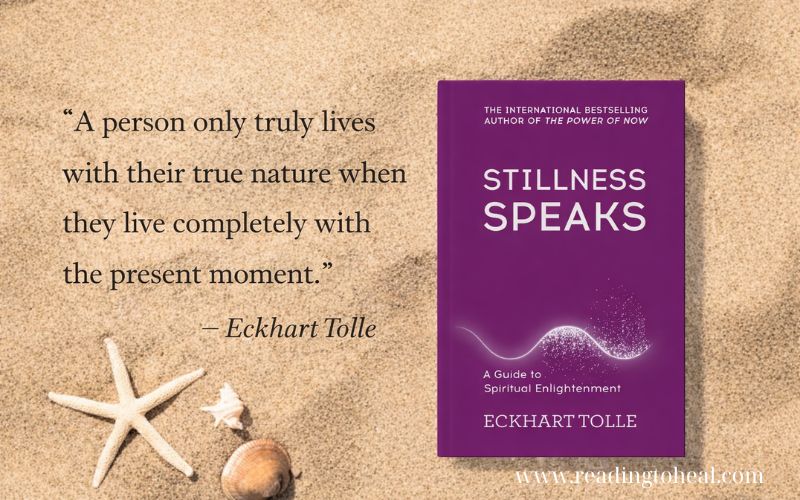
"A person only truly lives with their true nature when they live completely with the present moment."
Living in the present moment is the stillest way of living, and that is truly life.
But the present moment is often obscured by the past and the future. Many of us are living but not truly living because we do not live in the present. We are immersed in regret and pain over the past; we also hope we can escape the shackles of current work and immediate worries to truly live the life we have always dreamed of. We struggle internally, dissatisfied and resisting every day to find a way out. Our minds are like being locked in the cage of this struggle, worn to exhaustion yet still confused because we are personally covering the exit door. That is the door of reality, of living fully with reality.
Eckhart Tolle has said many times in his books: "Do not resist reality; be wholehearted with the present while following the intended plan of your life." Only then can you fully reach your destination.
Do not treat the present as an obstacle you need to overcome, because the future is something that will never come. Living only toward it, you will only create an undercurrent of dissatisfaction, tension, and never-ending discontent. A lifestyle that does not respect life and does not take responsibility for this moment, this life. An attitude of resisting life is an attitude by which you deprive yourself of your own success.
Be wholehearted with everything even if you do not like it; it doesn't matter, because this feeling is actually the resisting attitude of the intellect. It is always like that, it likes to react. If you sow in it a sense of intact appreciation for the present moment, the tendency for reactive thinking will gradually decrease.
"Do not pursue the past, do not long for the future" is the best way of living for a person.
The Buddha once said: "There is no happiness like the happiness of still moments." Living wholeheartedly in the present, you can feel your own peaceful nature - a joy that is simple, deep, sacred, and requires no conditions. Joy lies in the gap when the stream of incessant thinking in you slows down. The wider this gap of stillness, the more deeply you connect with your true nature, and the greater the joy.
Return to nature frequently
In addition to meditation and living mindfully - meaning staying completely in the present moment - to find your true nature, the author advises returning to nature frequently.
A tree, a stone, birds, a stream of water always possess pure stillness, always peaceful within themselves. They do not split themselves into two pieces like humans; they have no illusions, they do not try to protect or build up anything for themselves, and they do not try to become anything else.
They are just present with life as they are. When you return to and quietly observe nature, you can escape from the unconscious ego rooted in you that creates suffering and countless consequences for you. Nature can truly teach you the mysteries of life - that all things in the universe are one, including humans.
Everything is a single life, only expressed in many forms and colors throughout this universe. You suddenly perceive this world as a dance of countless vivid and miraculous forms. You will no longer have distinctions, no boundaries, no "I", "it", "my family", "my country".
Only when you truly transcend thought and can settle within can you come into contact with the silent world of nature, feeling the vast space enveloping nature and yourself. At this point, the ego will disappear, and compassion within you will bloom.
Nature will bring stillness to you. Return to it whenever you can. Watch, immerse, and feel; embrace every sound from the rustling of swaying leaves, the chirping of insects, the singing of birds, to the sound of falling rain...
Do not use the intellect to judge and examine. Learn true stillness from nature, and you will return to yourself.
Stillness to live better
Most relationships between humans are bound in the exchange of words and the world of thought, and it is very easy to create distorted and one-sided views of each other.
To grow a relationship strongly, there must be the existence of a spacious feeling that comes from stillness.
Stillness to connect with everyone
Stillness to listen deeply without losing yourself in the stream of thoughts judging others, which leads to words that hurt each other during moments of losing composure. Stillness to have enough space to accept the partner's differences and find a satisfactory and balanced solution for both sides.
For example, if you and a loved one disagree, if you react strongly instead of accepting their perspective, their character, and the way they behave, you will not be able to look deep into your own inner self to contemplate everything and see where the root cause is; you will not know what you can do to change this tense situation.
If you can detach yourself from the situation of the mind's resistance, then the space of stillness within you will save you from awkward situations in relationships. You will know you need silence, waiting for the right time to reconcile while the other person is hot-tempered.
In relationships, when meeting even for a few short minutes, dedicate full attention to being present - look and listen with alertness. Do not wear down your ability to focus and your stillness by scrolling through your phone while trying to talk to someone just to fulfill your role, or treating them as a means to achieve your purpose.
When you are completely present with anyone, you eliminate the past and the future from that moment. All judgments and prejudices from the past regarding the interpretation of a person's nature, and evaluations through the minds of others, no longer affect your perception of them. You gain freedom, and that person is not trapped in prejudices about themselves, creating conditions for both sides to return to their true nature.
Many say that an intellectual understanding of a person (for example, a business partner to discuss important matters, a job interview, a negotiation) is necessary and useful for practical life. However, ultimately, this understanding also aims to achieve one's own goals and is only an artificial wall. The relationship will be limited and separated, unable to root into the state of being-at-ease because it has been conditioned by the intellect. If you have chosen the path of awakening, you will no longer want to live like that.
Stillness will open up wisdom
Furthermore, stillness can open up wisdom for you. Zen Master Ajahn Chah once said:
"When the mind is quiet, deep understanding naturally arises; there is no need to search for it anywhere, because that understanding is hidden deep in stillness."
All the wisdom of a person is only obtained through the ability to keep one's heart quiet. Stillness is where creativity and solutions to your problems will arise.
Like Albert Einstein or Isaac Newton and many other geniuses, to bring inventions and artistic masterpieces to life, they did not merely strive to practice skills and cultivate knowledge; each of them possessed stillness and always sought spaces of stillness and solitude - where intelligence and vastness, superior to all human intellect, is the place where creative energy explodes.
As the theologian and poet Rumi once said: "In the silence of the soul, you will find the answer to every question."
Therefore, when encountering any problem that needs solving, or a deadlock in work or life, do not try to struggle in the mind to find a solution. Use the mind to see the problem clearly and then give yourself a space of quiet relaxation.
At this time, the vast dimension of wisdom can begin to operate through you, permeating through thought and giving you a surprising solution. Especially for those doing creative work, art, dance, education, psychological counseling… one should meditate to help the mind be still and more abundant in creative energy.
Even the enlightenment of the Buddha himself came from stillness when he sat under the Bodhi tree. He also wanted to convey that:
"A still mind will help you give birth to wisdom."
Stillness to accept the nature of impermanence
Humans are the only species aware that they will one day have to die and will have to suffer when facing the death of loved ones.
We may not be afraid when talking about our own death, but everyone is afraid when mentioning the death of loved ones. In fact, we and those beside us are dying a little every day. Facing any unwanted situation in life, we die a little part of ourselves: breaking up with a person you love, moving away from children when they grow up, each time we are ill, a failure… we are all afraid and want to avoid this feeling of emptiness and sadness. We consider that to be the nature of impermanence.
But in truth, that is only looking at impermanence by half. Impermanence means that every existence in the world is only temporary and cannot avoid change.
Today you are healthy; tomorrow you may be sick and a few days later you may recover. This morning you feel happy, but then by evening you might feel sad - yet we are not sad forever. Because of impermanence, we can be happy again.
We often only associate impermanence with death, separation, pain, and failure, and always divide life into two opposite poles: joy opposite sadness, unhappiness opposite happiness, birth opposite death. Therefore, we keep trying to avoid one side of impermanence (suffering, illness, death) and try to hold onto and do everything to have this other side of impermanence. Eventually, the fear of impermanence drowns you in suffering.
Only when you realize and accept the impermanent nature of all things - that everything is temporary, has ups and downs then ups again, has birth and death then birth again - can you have a sense of peace from within the soul.
Yoga Master Yogananda reminded us:
"In stillness, you no longer feel afraid or confused by the changes of life. You realize that everything is passing and every existence is impermanent. By accepting this, you free yourself from suffering."
In stillness, we will feel that each existence, each state is just a small part of a larger picture of impermanence.
Practicing stillness is not avoidance or blind optimism, but a way to face impermanence calmly and freely. In that silence, we understand that change is not pain but an opportunity for us to open the door to our own growth and freedom. Standing amidst the storms of life, we find peace and strength in the stillness of the soul, and from there we know we can face any challenge that life places before us.
A message from the book Stillness Speaks
Although life still has many concerns, worries, and responsibilities revolving around daily bread and butter that we must face, how we face them is entirely our choice. Burden or joy, pain or experience, loss or growth - all are decided by how stillness shapes each person's perception.
During our days off, I hope everyone can return to nature, be whole with the present, practice the ability to be still and connect with their own roots, and be able to live with their true nature. Finally, Reading To Heal would like to gift everyone a poem by the famous Persian poet and theologian Rumi:
"The soul is a large house,
Let it become a place of peace
Where darkness cannot invade
And only brilliant golden light remains.
In stillness, we find peace,
Cold rocky mountains turn into glowing fire,
And in every breath, we realize that
Life flows on without ceasing.
Sometimes silence is the symbol
Of a bright and free heart,
And when we step into the world of stillness,
We find everything precious."