Man’s Search for Meaning: All Suffering Is Here to Save You
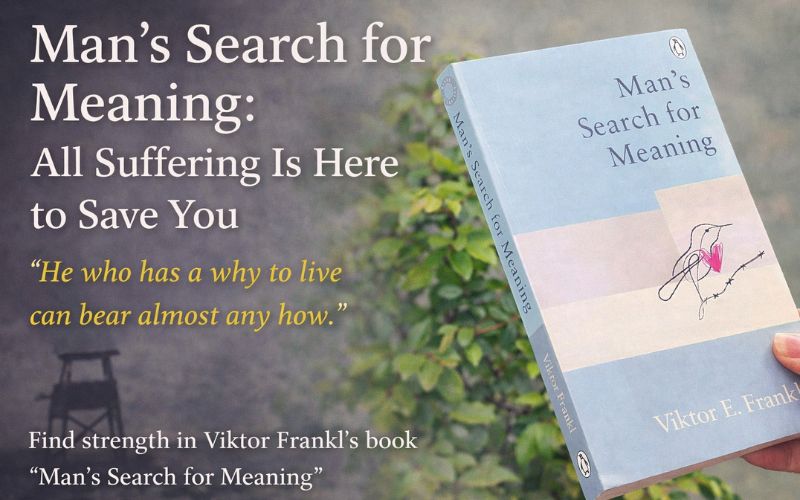
Man’s Search for Meaning is one of the ten most influential books selected by the United States Congress. To date, it has been translated into 24 languages and is renowned worldwide, and its author, Viktor Frankl, has been hailed as a man of miracles of the 20th century.
During the Nazi era, as a Jewish man, Frankl was imprisoned in a concentration camp known as a “factory of death.” Yet he not only survived that hell but also pioneered a way to rekindle meaning in life for people who were sinking into despair.
The book is divided into two parts: the first records the author’s experiences in the concentration camp; the second combines his lived experiences with academic theory to create a therapeutic approach that helps people rediscover meaning and rebirth from dead ends, and from there reclaim a glorious path in their own lives.
If you are struggling with pain and despair in life, if you are overwhelmed by confusion, sorrow, and fear, you can find strength in this book. Let us join Reading To Heal, together with Viktor Frankl, in searching for meaning in our own lives.
During the Nazi era, as a Jewish man, Frankl was imprisoned in a concentration camp known as a “factory of death.” Yet he not only survived that hell but also pioneered a way to rekindle meaning in life for people who were sinking into despair.
The book is divided into two parts: the first records the author’s experiences in the concentration camp; the second combines his lived experiences with academic theory to create a therapeutic approach that helps people rediscover meaning and rebirth from dead ends, and from there reclaim a glorious path in their own lives.
If you are struggling with pain and despair in life, if you are overwhelmed by confusion, sorrow, and fear, you can find strength in this book. Let us join Reading To Heal, together with Viktor Frankl, in searching for meaning in our own lives.
Choice - The Last Freedom of Human Beings
“You can take everything away from a person except the freedom to choose.”
In the 1930s, all of Europe was engulfed in the terror of Nazism. At that time, Frankl was the head of the neurology department at a hospital in Vienna, the capital of Austria, and he had a happy family.
To protect Frankl’s safety, the U.S. consulate in Vienna offered him an immigration visa. However, he refused, as he could not bear to abandon his parents, family, and patients. Unexpectedly, just a few months later, the Nazis occupied Vienna. Frankl, his wife, parents, and siblings were all arrested and sent to concentration camps.
Like Frankl, 1,500 others suffered the same fate. Many of them were businessmen, doctors, teachers, and scientific researchers - people who had once lived with dignity and respect, now reduced to trampled prisoners.
They constantly faced the threat of gas chambers, crematoria, or being beaten to death. All their belongings were confiscated, and they were confined like cattle. Each day, they were given only a small piece of bread and a bowl of thin soup, forced to wear flimsy clothing, and made to repair railways and perform heavy labor.
At night, they huddled on wooden boards, nine people sharing two blankets, using muddy shoes as pillows. If they were even slightly careless and encountered guards in a bad mood, they would be brutally beaten. Worse still, once their bodies collapsed and they could no longer perform hard labor, they would be sent to the gas chamber to end their lives.
Faced with such extreme suffering, almost everyone in the concentration camp had contemplated suicide. The easiest way was to throw oneself against the electric fence. Ending one’s life permanently was not difficult; continuing to survive was the hardest thing of all.
So what enabled the author of Man’s Search for Meaning not only to retain his will to live but also to struggle desperately against the current to save his own life? For him, it was first and foremost the right to choose.
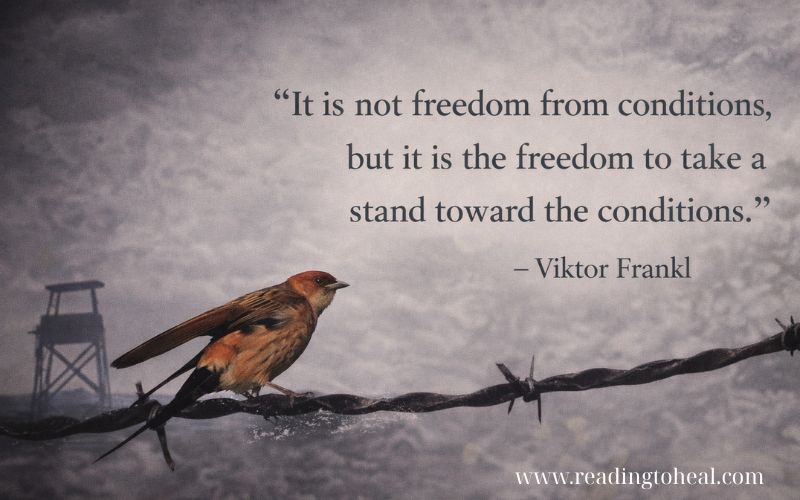
He firmly believed that even under the worst psychological and physical conditions, human beings can still maintain a certain degree of spiritual freedom and independent consciousness, allowing them to choose their own behavior and responses, and to decide what kind of person they want to become.
The first time Frankl was forced to shower naked in the concentration camp, he realized that apart from their naked bodies, everyone possessed nothing at all.
Everything external to one’s inner self can be taken away at any moment by some uncontrollable force. But the one thing that can never be taken away is the freedom to choose how you respond. We cannot control what happens in our lives, but we can control our emotions and actions when facing these events.
Every prisoner in the camp endured the same harsh living conditions, yet their responses differed: some chose to give up, some chose numbness, and others chose unwavering perseverance. When confronted with pain, what will you choose?
Consider this classic dialogue by a French writer:
-
“Do you truly love life?”
-
“Yes, I love life.”
-
“Have you ever suffered?”
-
“A few times, but suffering itself is life.”
Human life is like the sea, with rises and falls, drifting without knowing where it will go, while suffering is like tidal waves that rush in again and again. There is no life filled only with sweetness and no bitterness, nor a life of only bitterness without a trace of sweetness. Life is inherently full of ups and downs, and suffering always accompanies it. That pain may come from the sudden loss of a loved one, from being left alone and helpless, or from an unexpected accident.
No matter how difficult life becomes, everything will eventually pass. Fragile flowers can still bloom in cracks of stone; towering trees can still stand tall in desolate lands - and so can you. There is always a choice beyond giving up, beyond surrender, beyond self-blame: the choice to face difficulties bravely and never give up easily. With that choice alone, even standing at the edge of an abyss will not cause you to sink and fall.
Therefore, remember that everything in this world follows cause and effect. Everything that makes you suffer is here to save you.
While Viktor Frankl emphasizes inner freedom in the face of suffering, Louise Hay’s You Can Heal Your Life invites readers to explore self-love and healing through a different, more inward path.
Further Reflection
If you’d like to sit more deeply with Viktor Frankl’s wisdom, you may enjoy this curated collection of the most powerful quotes from Man’s Search for Meaning-grouped by suffering, resilience, choice, kindness, and meaning.
👉 Read: Man’s Search for Meaning – Powerful Quotes by Viktor Frankl
If you’d like to sit more deeply with Viktor Frankl’s wisdom, you may enjoy this curated collection of the most powerful quotes from Man’s Search for Meaning-grouped by suffering, resilience, choice, kindness, and meaning.
👉 Read: Man’s Search for Meaning – Powerful Quotes by Viktor Frankl
Suffering Makes You Stronger
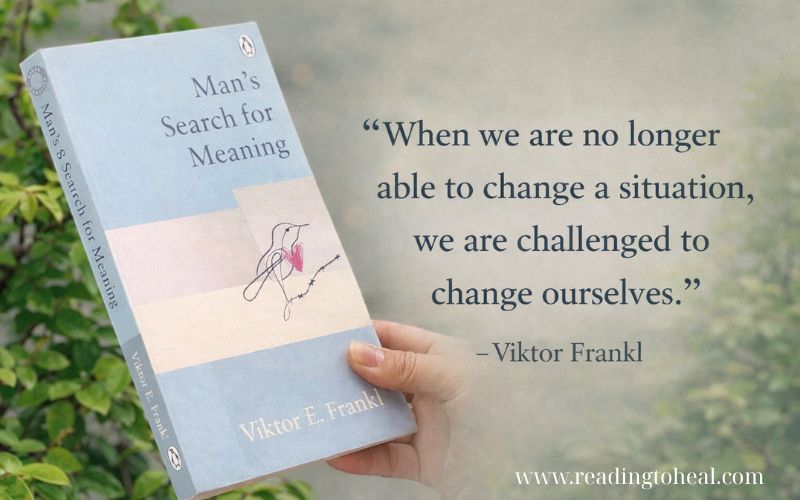
- Viktor Frankl
Reading To Heal suddenly recalls a passage from the novel One Hundred Years of Solitude:
“We walk on the eternal journey of life, run along rugged roads, revive through failure, sorrow clinging to our bodies, suffering scattered everywhere. We are exhausted but cannot stop; we are in pain but cannot avoid it.”
Suffering is a constant in life. Once we understand this, our minds can remain calm in the face of challenges. In other words, suffering always has its positive side. As the great poet Goethe once said: remember everything that suffering leaves behind - when suffering passes, it becomes sweet. Life is a seasoning of highs and lows; the more it is ground, the richer its flavor becomes. A similar idea appears in Maye Musk’s memoir A Woman Makes a Plan, where she reflects that what does not kill us ultimately makes us stronger.
Like the author of Man’s Search for Meaning, despite his strong will to live, the relentless torture eventually plunged Frankl into despair. Like his fellow prisoners, he suffered from severe edema, illness due to prolonged lack of food, clothing, and sleep. His feet were swollen, and every step was excruciating.
Later, while assigned to care for patients, he contracted typhoid fever and nearly ended up in the crematorium. Standing on the brink of death time and again forced him to rethink the meaning of life. Observing all kinds of people in the camp, he found that as long as someone still held the image of a loved one in their heart, they would never give up on life. Thus, he decided not to let himself perish from exhaustion or illness, but to treat the concentration camp as a place for psychological training.
When other prisoners lost themselves, he taught them to transcend suffering through humorous jokes. When they grew despondent and wanted to abandon hope, he encouraged them with meaningful speeches. Even while suffering from typhoid fever and facing death at any moment, he continued to jot down notes on scraps of paper in preparation for publishing his future psychological work.
Three years of imprisonment strengthened his heart and gave him profound insight into human nature, enabling him to develop a unique psychological therapy. Physical pain became the driving force behind his boundless spiritual motivation.
Frankl once said that only after experiencing hellish suffering can people develop the strength to create heaven. Only after bone-chilling cold can red roses bloom in the wind. Only after the agony of broken wings can an eagle soar high in the sky.
We always fear failure and crisis, unaware that it is precisely these bitter hardships that pave the road for our ascent. Those people you resent, and those experiences that cause you pain, will all transform into nourishment for your rebirth. There is no pain that cannot be healed, and no collapse that cannot end.
Human nature seeks advantage and avoids disadvantage, but if we understand that extreme hardship is where spiritual transcendence becomes possible, we will never see suffering as a disaster, nor feel unfortunate when facing adversity.
Frankl believed that suffering, misfortune, and death are inseparable parts of life. A human life is incomplete without suffering and death. Even in suffering, one can hold one’s head high, savor what suffering brings, and feel proud of having endured it.
As Dostoevsky once said, “I fear only one thing: that I may not be worthy of my suffering.” So what must we do to be worthy of what we have endured?
Searching for Meaning
- Viktor Frankl
“He who has a why to live can bear almost any how.”
This quote from Nietzsche is also the motto Frankl used to explain the importance of meaning in life. Beyond all suffering lies meaning.
In the concentration camps, Frankl witnessed many deaths not caused by starvation or lack of medicine, but by the loss of a reason to live. Statistics show that the highest mortality rates occurred around Christmas, as many prisoners hoped to return home before then. When that hope vanished, their spirit collapsed. Mental breakdown severely weakened physical resistance and led to death.
The same phenomenon occurs in modern life. Many people suffer from depression and psychological disorders because they cannot find meaning in life and lose their direction. Therefore, Frankl proposed that what keeps people alive is not hope, but meaning. Human beings live to search for the meaning of their own lives - something even more important than pursuing pleasure or avoiding pain.
In Man’s Search for Meaning, the author presents three ways to discover meaning in life:
-
Creating meaningful work or pursuing a specific career (achievement through work).
-
Experiencing love and care for a particular person.
-
Adopting a courageous attitude toward hardships and critical moments in life.
Nothing in the world helps people survive more effectively than realizing that their lives have meaning. The meaning of life encompasses the entire cycle from birth to death, including hardship and struggle. Therefore, open your heart and experience life as it is, regardless of how much suffering or happiness it contains.
Shining After Adversity
You gain as much as you can endure.
After being liberated from the concentration camp in 1945, Frankl found himself in unbearable loneliness. His parents, younger brother, and his beloved pregnant wife all died in captivity due to illness and starvation. The fellow prisoners who survived alongside him emigrated to other countries.
With no family and no friends, he decided to return to his former profession as a psychiatrist to help those traumatized by war. He threw himself into his work, combining personal experience with academic knowledge to create Logotherapy. Through lectures and counseling, he saved countless parents contemplating suicide after losing children, husbands unable to let go of deceased wives, and thousands of strangers living in confusion.
He rewrote the manuscript and completed Man’s Search for Meaning in just nine days. Over the following decades, he wrote more than 30 books and traveled the world giving lectures. Surviving death ignited an immense passion for life within him, and he was always ready to embrace new experiences.
At age 67, he began learning to fly and obtained his pilot’s license within months. At 80, he challenged himself with outdoor sports, climbing the highest mountain range in Europe. Even past 90, he continued meeting visitors from around the world and personally replying to letters each week to answer their questions.
It can be said that war destroyed Frankl’s life and took away his loved ones, yet he chose to rise from the ashes of suffering and shine like a radiant halo.
There is a saying that suffering is a stepping stone for geniuses, a blessing for the capable, and an abyss for the weak. Suffering is always a test - a compulsory course in your life. The more pain you can endure, the greater achievements you can attain.
Lessons from Man’s Search for Meaning
From choice, to transcending suffering, to ultimately grasping the profound meaning of life, Frankl’s life has left an undying source of inspiration for millions around the world. The logotherapy he founded continues to help humanity.
Compared with psychoanalysis, logotherapy focuses less on delving into the past and inner conflicts, and more on future goals and the core purpose of existence. Freud believed the primary drive was the pursuit of pleasure; Adler believed it was the pursuit of superiority to overcome inferiority; Frankl believed it was the pursuit of meaning. Searching for meaning is the fundamental motivation of existence.
Human life is like a surging river - without islands or hidden rocks, it cannot create magnificent waves. Life becomes richer when we actively train ourselves in hardship. Only by crossing depths never experienced can we reach heights once thought unattainable.
When a person finds meaning, they not only feel happiness but also gain the strength to face all difficulties in life. May we all, when facing hardship, suffering, and failure, take Man’s Search for Meaning as our companion - to transcend, to cultivate inner strength.
Live your present life as if you were living it for the second time.