
Lean In: Freedom Is Daring to Move Forward

Today, join Reading To Heal as we explore this book in detail!
Invisible Prejudices That Prevent Women from Leaning In
If we look at Sheryl Sandberg’s biographical highlights, we would think she has had a successful career and an incredibly smooth life. After all, she graduated from Harvard University with a bachelor's degree in economics, served as a consultant to the U.S. Secretary of the Treasury, and became the Chief of Staff for the President of Harvard.
Later, she worked at Google and reached the position of Vice President of Global Online Sales and Operations. In 2008, she joined Facebook as the Chief Operating Officer (COO). By 2012, she became the first woman to be elected to Facebook’s Board of Directors. Throughout her tenure, Sheryl has been considered one of the most influential and powerful figures in this tech giant.
Hearing this, many of us surely admire Sheryl Sandberg’s success, advantages, and seemingly peaceful life, right? However, after reading Lean In, you will realize that any woman faces difficulties in the workplace that men cannot understand. The truth is that the entire society is subtly placing invisible pressure on their shoulders.
Do you see? These rates indicate that in many countries around the world, both men and women have equal opportunities to study, earn degrees, and find jobs. But in reality, very few women hold senior positions in companies.
In Lean In, Sheryl Sandberg shares a story about the first time she went to a financial corporation to host a high-level meeting. When she asked where the women’s restroom was, the employee there was stunned and said, "There is no women’s restroom, because there are no women working here."
People usually expect men to have a career, but what is expected of women? This society often perceives that a woman is happy as long as she marries a good man. The sad thing is that this notion even exists within many women themselves.
Back when Sheryl Sandberg had the opportunity to study abroad, when her boyfriend picked her up at the airport, his boss was also there. He pulled her aside and said: “There aren’t many good men like that.” Standing there at that moment, she felt nothing but loneliness. Loneliness because she felt it was too bitter - for a woman who wanted to work hard for her future, society was still transmitting a message that it is better for a woman to get married and have children early.
Or look at children's clothing produced by Gymboree; they often print "Smart like daddy" on boys' shirts and "Pretty like mommy" on girls' shirts. This was happening in 2011 - in a modern, civilized era of human progress, people were still encouraging girls to just be pretty like their mothers.
In this society, we often hear criticisms that a woman in a high leadership position is "too strong" or "too smart," and that she will find it hard to get married. Furthermore, many people implicitly believe that such women cannot easily achieve both a successful career and a fulfilling personal life.
Conversely, for men, having both at the same time is never questioned. Therefore, Sheryl Sandberg argues that in communication, the greatest insult to a woman is not asking how much she weighs or how old she is, but asking: "How do you balance work and life?"
Dr. Judith Rodin, the first female president of an Ivy League school and President of the Rockefeller Foundation, once told female students in a speech: “Our generation fought to give you the freedom to choose everything. We believe in freedom, but we didn’t think you would choose to give up your jobs.”
So many people across previous generations fought so that future generations would have work conditions as good as men. Yet, in today's society, too many women give up this opportunity. They quit their jobs and retreat to take care of their families full-time. They don't dare to move strongly toward their own careers. They yield, and sometimes, they endure.
Why do women let these unfair societal conventions bind them and block their steps? In fact, many social science studies from various governments have proven that when both parents have their own careers, the children, the parents, and the marriage can all flourish. When a woman can share the economic burden of the family, her feelings of restlessness and distress decrease. And when a husband participates in housework, the children grow up smarter and healthier.
Therefore, when a woman has her own career and can take on various roles in life, her mental health and sense of life satisfaction will increase significantly.
Thus, a woman needs to overcome the chains of prejudice and social norms. She needs to conquer her fears: the fear of not being liked, the fear of being judged, the fear of failure, and even a fear that exists in the subconscious of many women today and in the past - the fear of being a bad mother, wife, or daughter.
Instead of wondering how to live with this fear, please ask yourself: What would you do if you weren’t afraid?”
So, how will you change the reality of inequality between men and women, and what will you do to make life happier and more successful? In the next section, Reading To Heal will share with you 8 valuable pieces of advice from Sheryl Sandberg in this book.
One of the reasons Lean In remains so influential is the clarity of its language-especially in 7 best quotes from Lean In, where Sheryl Sandberg’s core ideas on women, work, and leadership are distilled with striking honesty.

Further Inspiration
Beyond the Table: A Lifetime of Adventure
Sheryl Sandberg shows us how to Lean In at work, but how do we stay resilient through life's harshest storms? Meet Maye Musk - the woman who survived domestic abuse and poverty to raise a family of legends.
Explore Maye Musk’s Story →8 VALUABLE TIPS FROM SHERYL SANDBERG

Instead of just lecturing, in Lean In, Sheryl Sandberg provides very practical guidance for women to confidently move forward and have a life of freedom and happiness.
Tip 1: Sit at the Table
In psychology, there is a syndrome called "Imposter Syndrome." This is a psychological phenomenon where, when faced with success or outstanding achievement, a person wavers between two feelings: narcissism, or feeling that they do not deserve that success, feeling instead like a fraud. Women often experience the second feeling more.
Once, when friends congratulated Sheryl for being named one of the 100 most influential women in the world by Time magazine, she felt embarrassed and said the ranking meant nothing. Later, her assistant spoke to her seriously: “Your response was terrible; you just need to say thank you.”
You see, even people with great achievements and success like Sheryl Sandberg suffer from Imposter Syndrome. Denying your achievements is not modesty; the root cause is that you are too used to underestimating yourself.
The reality is that women in the workplace are often used to sitting on the sidelines in meetings. The author did the same the first time she attended a meeting. As a result, a leader came out and told her: "Sit at the table. If you sit in the back, it means you don't want to participate."
That’s right, we must sit at the table. Overcome your fear and bravely take a step forward. By stepping forward, you have the opportunity to express yourself and your thoughts. By stepping forward, you have the opportunity to see a more developed and excellent version of yourself.
Equally important: when you achieve something, accept it with confidence, pride, and self-praise. Be confident when you start something and be confident when you achieve results. Moving forward and sitting at the table is the first step to reclaiming fair evaluation and respect in the workplace.
Tip 2: Don’t Leave Before You Leave
What does this mean? It means Sheryl Sandberg wants to pull you back to the present so you can focus on the work you are doing, which is the only way to succeed.
Women often worry about things that haven't happened yet: they aren't at marriageable age yet but worry about the future of married life; they aren't pregnant but fear what they will do when they have a child; they worry about childcare...
Because of these plans for marriage and children, women often make decisions to leave their jobs. But more seriously, many people who do go back to work have a voice inside them torn by worries for their husband and children. Finally, they shrug: "Fine, I'll sacrifice for the family."
You need to know that whether male or female, we are all at equal positions on the starting line of the career marathon. Halfway through the race, men always hear cheers: "Great job, keep going, get to the finish line!" Meanwhile, women hear things like: "Maybe you're doing great, but you can't finish this race. Your child at home needs you; why are you still thinking about continuing to run?"
You might think that spending a large portion of your life caring for your family is your divine duty as a mother and wife. But in reality, these are deep-seated thoughts that erode a woman's mindset. If you believe them, you will let yourself be persuaded by everyone to give up and retreat to care for the family.
But now is the time to look back. You need to fight to balance this gender inequality. Faced with the choice of being persuaded to quit, move forward bravely to do what you truly desire and bring value to life. Listen to your inner voice and be yourself.
That is why Sheryl Sandberg advises that women should not hit the brakes while they are still accelerating. Always be ready to hit the gas to move forward because if you truly want to develop your career and live your own life, you will find a way to handle, arrange, and balance work and family. You will find a way to negotiate with your husband to share family duties.
The author uses her own experience to tell us that she was pregnant while working at Google. With a baby bump, she still performed her job well. After giving birth, she only took 2 to 3 months before returning to work. So, don't leave before you leave; conquer the fixed mindset and focus on developing the work you love.
Tip 3: Make Your Partner a Real Partner
What is a life partner? It is two people with equal responsibilities and rights walking together through life. If a woman wants to have her own career, she also needs support from her husband.
The reality is that many women do not allow others to interfere in their work. There are tasks they feel only they can do, and no one can replace them. Why is it that in most families, all housework falls on the mother and only the mother can do it well?
Actually, that’s not the case. Women should learn to delegate household authority to men and encourage the whole family to participate together. If you want to build a gender-equal society, start by making everything equal in your own home, making your partner a true partner.
Tip 4: Done Is Better Than Perfect
“Done is better than perfect” is a working motto at Facebook. Finish it first; don't be a perfectionist. Because if you pursue perfection, you are very likely to fail.
This is also true in balancing a woman's life because many women often feel guilty for not being able to have it all: housework must be perfect and company work must be successful.
If you are on a business trip and your son calls saying, "Mom, I miss you so much," a woman easily feels guilty for neglecting her child. But in reality, no one thinks that - not even her child.
However, this natural guilt in women is very difficult to explain; it may be related to maternal duty and deep-seated anxieties. Therefore, women need to learn how to balance and reduce their inner guilt.
Don't think that to balance, you only need to learn time management. Equally important is knowing how to control your internal emotions. Because when you are full of guilt or shame, you can never focus on a specific task.
A study by a Stanford professor indicated that setting goals is the key to happiness, but it’s not about trying to achieve everything; it’s about working hard to achieve the things we consider most important.
So, stop asking, "Can I do it all?" You don't need to be a superhuman woman; instead, ask yourself: "Can I do the things that are most important to me and my family?"
Tip 5: Dare to Be Disliked!
Two professors from Columbia and New York University conducted an investigation: they showed people stories about two equally competent people who became successful entrepreneurs - one named Heidi and one named Howard. After the survey, people said they were more willing to work with Howard than Heidi. Why? Just because Heidi is a woman and Howard is a man.
The results of this experiment show us that a man’s success is positively correlated with his popularity - meaning as they succeed, they are more easily liked, trusted, and supported. But for women, it’s not quite like that. As many women rise higher, they face more disapproval and dislike. That is also a reason blocking many women who want to advance higher in their jobs or careers.
As the founder of Facebook told the author: "You can't please everyone." No matter how good we are, there is no way we can satisfy and be liked by everyone.
Therefore, in the workplace, the author of Lean In advises: First, learn to be "relentlessly pleasant" to express your needs. Second, learn to release your emotions - cry if you want to. Third, learn to adapt to the word "powerful."
The author believes that society’s prejudice against strong women exists because people think women aren't suited for leadership roles, but once the percentage of women in senior management reaches 50%, people will naturally get used to it.
Tip 6: A Career Is a Jungle Gym
Many people think that advancing in the workplace is like climbing a ladder - one way up or one way down. However, Sheryl Sandberg points out that we need to view a career as a jungle gym, not a ladder.
On a jungle gym, people can climb horizontally, vertically, move forward, move back, or even go in a circle and come back. It’s the same for women, especially those who have to take a break for childbirth; they often feel fearful when returning to work.
Therefore, remember that you are on a jungle gym, not a vertical ladder. If you view your career as a ladder, you will always assume only those who are good enough climb to the top. But you don't need to force yourself into that. Conversely, when you are on a jungle gym, you can see in many different directions, your vision expands, and you can overcome fear and be ready to seize opportunities.
In reality, women often feel they must have 100% of the required skills before applying for a job, while men only need 60% to allow themselves to apply.
Thus, women need to change their mindset: Don't think "I'm not ready yet," but rather "I want to do it and I can learn while doing it." The author also advises that the way to maintain a jungle gym mindset is to have goals.
First, you must set long-term dreams - the big goals of your life: what you need to do to bring value to your life, change the world, or help society.
Second, have short-term goals for the next 18 months: In this year and a half, you need to ask yourself what you can do for your workplace or your own career.
Tip 7: Speak Your Truth and Feelings
It is a common truth that women in the workplace are very afraid to speak their minds because they fear offending someone, losing someone's favor, being seen as lacking team spirit, causing friction, or starting an argument. The reason they don't dare to speak their thoughts and feelings is that women have high empathy and sensitivity. Because of empathy, we fear hurting others; because of sensitivity, we don't dare to speak up to protect ourselves.
But compare these two statements: "You never seriously considered my proposal" versus "I sent you four emails and you haven't replied yet; I'm very disappointed. This makes me feel like my proposal isn't important. Is that true?"
Between these two ways of speaking, which do you think is more effective? Of course, the second one. It follows a certain communication principle: State the facts, state the impact of those facts, and finally, express the result and what you desire.
Tip 8: Start Talking About It
What issue must we talk about? Yes, gender equality. This issue is like a giant elephant in the room that everyone sees but pretends not to, even women themselves.
You need to know that voices can change perception, perception can change behavior, and finally, behavior can change institutions. If we want to change, first speak up and change your own perception. Fighting this inequality is, above all, a battle to change the mindset and perception of both women and men. The most important first step is to change the perception and mindset within yourself.
Message from Lean In
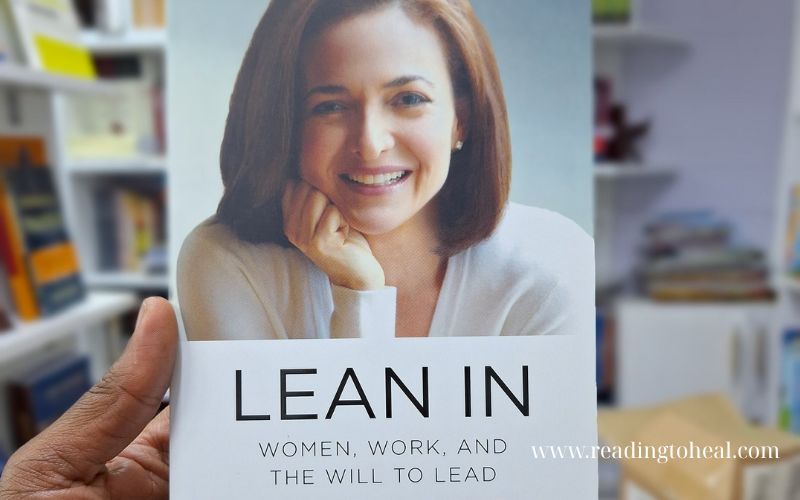
When Sheryl Sandberg wrote Lean In, she was not just a CEO but also carried many thoughts about this society. She hopes that men and women will become equal and society will be more harmonious. She participated in a TED Talk - an extremely good speech you can watch to learn more.
Of course, everything said in this book is her sincere voice calling on both men and women to strive for equality in society because it relates to everyone's happiness.
For Reading To Heal, when reading this book, we highly encourage the women around us to return to their inner selves, understand themselves, and understand what they are truly good at.
Bravely do the work you truly like, boldly start a business, or spend more time investing in personal development in life and work. But if you are not currently in a position to start a business, it is better to learn how to build a side hustle first. As a girl, conquer social notions; as a boy or anyone else, strive to be better than yesterday, work hard, and live life to the fullest.
Hopefully, Sheryl Sandberg’s Lean In will bring you many useful things. Thank you for reading. If you find this article helpful, please share it with those who need it to light up our awareness of the social reality and join hands to build a life where everyone is equal.
Related Read: Discover how to transform your health and destiny through the power of self-love in Louise Hay’s "You Can Heal Your Life" – Read to Awaken and Love Yourself .